I had another DAR meeting this weekend, so I wasn't able to prepare a post again this week, but I did want to give a little update on the family I mentioned last time. I went to our local genealogy library a couple of Fridays ago with the rest of the State's DAR members. My one goal was to find information about this Harris line (my supplemental ancestors).
Long story short: I found information about the family, but I'm not sure how helpful it is yet.
I found a lot of records for my "son" Patriot, John, and his second wife. I even found where he adopted his wife's children from her first marriage. I have a sneaky suspicion though that the service currently linked to John may not be for John. The source of John's service is the fact that his wife Lavinia received land through a land lottery for being the "widow of a Revolutionary War soldier."
She had been widowed twice by this point though. Sometimes, widows had to prove they were married to the soldier during the time of service to receive benefits on behalf of the man. She didn't marry John until 1816. Her previous husband died in 1809, and they would have been married during his time (if he did in fact serve) during the War.
AND I still haven't proven his first wife yet (my ancestor's mom). I don't "have" to prove her name, but I feel like it would provide a better argument for my case if I can show the prior applications using Lavinia as Lucy's mom are wrong. (Not to mention proving they were wrong about her dying before they got married!)
Then, for David, my other Patriot -- and John's father -- I was able to figure out through some of the ladies who have higher levels of access to previous applications what the nature of Captain David Harris' service was. I was able to figure out the names of the men he supposedly served under, so that will make proving his service with a new source infinitely easier than trying to figure out who is who amongst all of the David Harrises around Georgia at the time.
I'll keep you updated on the progress with this family in future posts, but that's it for the update for now.
Showing posts with label DAR. Show all posts
Showing posts with label DAR. Show all posts
Sunday, September 27, 2015

Sunday, September 13, 2015
No Post This Week
I had my first DAR meeting as an officer this week, so I didn't have a chance to prepare a post. I did spend some time working on my first supplemental applications. I thought I had them all figured out and ready to submit. Then, as I was finalizing my lineage worksheet, I noticed two big issues.
My first Patriot's wife was listed as dying before she was listed as marrying. Then, my second Patriot, the first Patriot's father, did not have any source of service listed for him. This means I have to reprove his service in the War.
I stayed up all night when I realized it trying to fix each issue. I can argue that Lavinia Harris didn't die until at least another 20 years after what they were married, but I won't be satisfied until I find an actual date of death for her.
David Harris' service is the thing that is bugging me though. I have found a man that could be my ancestor, but I can't prove it's him yet. We have a genealogy event at the local library this Friday. Hopefully I'll be able to clear some of this up then.
My first Patriot's wife was listed as dying before she was listed as marrying. Then, my second Patriot, the first Patriot's father, did not have any source of service listed for him. This means I have to reprove his service in the War.
I stayed up all night when I realized it trying to fix each issue. I can argue that Lavinia Harris didn't die until at least another 20 years after what they were married, but I won't be satisfied until I find an actual date of death for her.
David Harris' service is the thing that is bugging me though. I have found a man that could be my ancestor, but I can't prove it's him yet. We have a genealogy event at the local library this Friday. Hopefully I'll be able to clear some of this up then.
Sunday, August 30, 2015
Richard Rivers
This post is a little different, so just hang on and take this ride with me. Today, I was working on my great-grandfather's second spouse's family, and I came across a long line of DAR members. I have come across few families (at least in my family) as deeply rooted in the DAR as this one. A few of the Daughters in the line had submitted supplemental applications through other Patriot ancestors. It was through those supplementals that I came across my great-grandfather's wife's third great-grandfather, Richard Rivers, Esquire.
I don't know much about him besides what I have learned through the Daughters that entered under him. I know he was born before 1735 in Virginia. I know he was a Justice of the Peace in Johnston County, North Carolina in 1776. (That qualifies him for civil service with the Daughters of the American Revolution.)
I know he married a woman named Mary, and together they had at least one son named William. All 17 Daughters that have linked to Richard Rivers are through his son, William. All but one of those 17 Daughters descended from William's first marriage. My step-great-grandmother's line comes from William's second marriage.
This is a very new person in my tree, so I don't have much to go on yet, but Richard's source of service was from the North Carolina State and Colonial Records. Through Richard's source of service, I was able to find more information about a family I have been researching for years on my husband's side. I knew this collection of records existed, but at the time, it was a little too big of an undertaking. I mean, the shear volume of these records is intimidating to say the least. I am glad Richard Rivers was able to give me the time to sift through (a very small piece of) this series today.
While I am still trying to find out what, if anything, Richard did as a Justice of the Peace, I did find the record of his being appointed in the records. I will leave that for you now. I have bolded the various counties represented in the mass-appointment. Hopefully you will be able to find your own Justice of the Peace among this list.
An Ordinance for appointing Justices of the Peace, Sheriffs, and Constables for the several Counties in this State, for erecting County Courts for the purposes of holding Sessions of the Peace and putting into execution the laws relative to Orphans, Guardians and highways until provisions shall be made by the General Assembly of this State for the same.
Be it ordained and declared by the Representatives of the Freemen of the State of North Carolina in Congress assembled, and it is ordained by the authority of the same, That William Blewitt, Thomas Wade, Charles Medlock, Matthew Raiford, James Picket, Stephen Miller, John Jackson, James Auld, Henry Munger, William Pickett, David Love, John Chiles, George Davidson, Robert Thomas, Cornelius Roberson, John Kimbrough, James Allen, William Hay, William Coleson, John Wall, John Caruth, William Coleson and Thomas Lacy, Esquires, of the County of Anson; John Barrow, Samuel Boatwell, Thomas Respess, James Bonner, Thomas Bonner, Thomas Pevice, Francis Jones, William Brown, Henry Bonner, John Smaw, Robert Tripp, William Boyd, John Kennedy, Reddin Blount, Junr., John Tripp, for the County of Beaufort, Isaac Jones, George Brown, William McRee, John Smith, John Turner, Archibald McKeesick, Abraham Barnes, John Grange, Thomas Owens and Thomas Brown, Esquires, for the County of Bladen; Thomas Pugh, William Gray, John Campbell, James Campbell, George Lockhart, Peter Clinton, John Freeman, Thomas Ward, William Ghoby, Humphrey Hardy, Jonathan Jacocks, Simon Turner, Andrew Oliver, William Bryan, Thomas Rhodes, Reubin Norfleet, James Bryan, Abner Eason, William Benson, George Ryan and William Pugh, Esquires, for the County of Bertie; Richard Quince, Isaac Marion, John Davis, Edward Wingate, Thomas Davis, Richard Quince, Junr., Parker Quince, Robert Snow, Robert Ellis, Robert Schaw, John Rowan, John Bell, Samuel Walters, Roger Davis, Thomas Neale, William Gause, Lewis Dupre, John Fergus, and Needham Gause, Esquires, for the County of Brunswick; Osburn Jeffries, William Johnston, Philemon Hawkins, Benjamin Ward, James Ransome, Jr., William Person, Henry Hill, Thomas Turner, Matthew Thomas, Philip Burfurd, James Ransome, Senr., Young McLemore, Thomas Miller, James Paine, Green Hill, Edward Jones, William Alston, Robert Goodlow, Esquires, for the County of Bute; Joseph Leech, James Davis, Jacob Blount, John Benners, John Carruthers, Richard Ellis, John Fonviele, John Tillman, Edward Franks, William Bryan, Emmanuel Simmons, Alexander Gaston, Jacob Johnston, John Bryan (Trent), William Randall, William Carraway, Bazil Smith, William Tisdale, Silas Stevenson, John Gilyard, and John Carney, Esquires, for the County of Craven; Valentine Wallis, Lewis Welch, William Thompson, Soloman Sheppard, Micajah Frasier, Joseph Bell, David Wallis, Joseph Bell, Kittarel Mundine, John Easton, Thomas Chadwick, Jacob Wade and John Williams, Esquires, for the County of Carteret; Richard Stanley, Kedar Marchand, Samuel Jarvis, Thomas Williams, Willis Etheridge, Nicholas Leving, Taylor Jones, John Nathen, John Powers, Thomas Jarvis, William Ferebee, Nathan Poyner, John Humphries, John Simons, Stephen Brooks, Spencer Hall, Zebulon Williams, Samuel Midgett, Caleb Simons, Maliche Merchant, and Thomas Miller, Esquires, for the County of Currituck; Demsey Sumner, Joseph Blount, Edward Vaile, Senr., Joseph Hewes, Thomas Bonner, John Baptist Beasley, James Blount, James Sumner, William Boyd, Robert Smith, Jacob Hunter, Jethro Benton, Luke Sumner, Thomas Benbury, Thomas Hunter, Josiah Granberry, Charles Bonfield, Joseph Underhill, and William Roberts, Esquires, for the County of Chowan; David Smith, Robert Rowan, William Sprowl, Robert Cobb, Alexander McAllister, Archibald McKay, William Scale, Thomas Matthews, Junr., James McDonald, Gilbert Clark, Philip Alston, Thomas Hadley, Ica Atkins, Alexander Avery, Walter Murray, John Robertson, Charles Campbell, John Matthews, Peter Mallet, John Lyon, William Stringfielder, Theophilus Evans, Robert Cochrane, James Dyer, Esquires for the County of Cumberland; Robert Rutherford, Alexander Clark, Matthew Jones, John Thomson, Balaam Thompson, Charles Matthews, John Ramsey, Richard Kennon, James Sellars, Samuel Stuart, John Nall, and Gray Barbary, Esquires for the County of Chatham; Thomas Edwards, Henry Goodman, Robert Simms, William Hooker, Thomas Williams, William Whitfield, Junior, Robert White, Junior, George Miller, Joseph Pipkin, Constantine Whitfield, John Cobb, Joshua Herring, William Sasser, Spyers Singleton, and Etheldred Ruffin, Esquires for the County of Dobbs; John Sampson, William Houston, Thomas Rutledge, Richard Clinton, James Kenan, William Ball, William Dixon, Thomas Hix, Robert Dickson, Richard Herring, William Taylor, and James Lockhart, Esquires for the County of Duplin; Acquila Sugg, Edward Moore, Samuel Ruffin, Duncan Lamon, Elisha Battle, William Haywood, Sherwood Haywood, Henry Irwin, Joseph Williamson, John Thomas, Matthew Drake, Noah Sugg, Robert Bignall, Nathan Bodie, Exum Lewis, Jonas Johnston, William Hall, Isaac Sessoms, Jacob Dickinson, Arthur Arrington, and Joseph Pender, Esquires for the County of Edgecombe; Robert Harris, Thomas Person, John Pope, William Burford, Jonathan Kitrell, David Mitchell, Robert Lewis, Thornton Yancey, Charles Rust Eaton, Memucan Hunt, John Young, Thomas Bankes, John Taylor, Samuel Smith, Henry Lyre, and John Oliver, Esquires for the County of Granville; Robert Lindsay, Alexander Caldwell, Charles Galloway, Robert McKinnie, William Gray, William Coles, James Martin, Philemon Deatheridge, Joseph Hines, William Gowdy, Adam Lackie, John Collier, James Brown, John Burton, William Clark, John Harris, George Costner, Gabriel Scot, and James Park Farley, Esquires for the County of Guilford; Rotheas Latham, Thomas Jones, Thomas Jordan, William Russell, Benjamin Parmelie, Frederick Baron, Burridge Selby, Robert Gibbs, Benjamin Holloway, Richard Harvey, Phineas Latham, Joseph Hancock, and John Poole, Esquires for the County of Hyde; Matthias Brickel, George Little, Lawrence Baker, James Wright, William Murfree, James Boon, John Harrold, John Northcut, James Reddick, Edward Hair, Josiah Sumner and Benjamin Brown, Esquires for the County of Hertford; Montfort Elbeck, John Bradford, William Branch, Philip Kearney, Egbert Haywood, Joseph John, William Samuel Weldon, John Jones, Charles Paitner, John Geddy, James Allon, Cullen Edwards, John Young, Jeremiah Nelmes, Willis Alston, Willie Jones, John Whitaker, Benjamin McCullock, and John Branch, Esquires for the County of Halifax; William Bryan, Henry Raines, Nathan Williams, Samuel Smith, Needham Bryan, John Hinnant, William McCullers, John Stevens, John Smith, Alexander Avery, Elisha Thomas, William Avery, Richard Warren, Richard Rivers, Phillip Raiford, William Hinnant, Charles Wilkinson, Kedar Powel, Henry Finch and Thomas Lee, Esquires for the County of Johnston; Paul Barringer, Robert Harris, Richard Berry, Martin Phifer, Abraham Alexander, Adam Alexander, Henry Downes, Hezekiah Alexander, David Reese, John Davison, Robert Irwin, John Ford, John McKnit Alexander, Ephraim Brevard, Jeremiah McAfferty, Robert Harris, Junior, James Harris, and Abraham Barnett, Esquires for the County of Mecklenburg; John Hardison, Edward Smithwick, William Slade, William Sherrod, John Lewellen, John Everit, Whitmell Hill, Thomas Wiggins, Thomas Hunter, Kenith McKenzie, Francis Ward, Samuel Smithwick, Samuel Williams, John Ross, John Kennedy, John Griffin, Nathan Mayo, Blake Baker Wiggins, Joshua Taylor, John Perry, James Moore and Thomas Riddick, Esquires for the County of Martin; John Hardee, John Simpson, George Moye, Lazarus Peirce, Amos Atkinson, Peter Reaves, John Williams, Robert Salter, Edmund Williams, Frederick Gibble, John Bower, James Lanier, David Perkins, William Hines, James Latham and William Travis, Esquires for the County of Pitt; John Brevard, Griffith Rutherford, George Henry Barringer, Moses Winslow, William Sharp, Robert King, James Brandon, John Johnston, Andrew Hunt, Jacob Nichols, Matthew Troy, Michael Brown, Israel Cox, Robert Moore, James Carr, Henry Davis, Joseph Steel, William Moore, Christopher Beckman, Andrew Woods, Charles McDowell, Hugh Brevard, Ephraim McLaine, John Perkins, John Conelly, Robert Holmes, Francis Cunningham, Matthew Sharp, Robert Blackburn, James Davison, Esquires for the County of Rowan; Martin Armstrong, William Hall, Charles Macanally, Jacob Boon, Robert Lanier, Benjamin Cleveland, Samuel Freeman, John Hudspeth, Michael Howzer, Matthew Moore, Joseph Winston, Richard Good, Thomas Johnston, Benjamin Hearndon, William Lanier, John Snead, William Dobson, Elisha Isaacks, Matthew Brookes, William Hawkins, Esquires for the County of Surry; Benjamin Blount, Giles Long, Joseph Spruill, Junr., John Hooker, Jeremiah Frasier, James Long, Thomas Horkins, Joseph Whidbee, Stephen Swain, Peter Wynns, Isham Webb, James Phelps, Junr., Benjamin Haril, John Wynns, Matthew Drivengreeses, Isaac Meekins, Edward Blount, Junr., Isaac Alexander, Junior, Richard Hough, Thomas Mackey, John Stubbs, Thomas Averit, Esquires for the County of Tyrrel; Joseph Harding, John Robertson, William Graham, George Lamkin, William Yancey, John M. Kinie, George Black, Robert Johnston, James McAffie, Frederick Hambright, Valentine Mauney, Jonathan Hampton, and William Nevill, Esquires for the County of Tryon; Joseph Lane, Theophilus Hunter, Thomas Hines, Joel Lane, James Martin, Abraham Hill, James Jones, Thomas Wooten, Tignal Jones, Thomas Crawford, Michael Rogers, Lodowick Alford, Joseph Davis, Albridgeton Jones, and William Walton, Esquires for the County of Wake; George Moore, Cornelius Harnett, Richard Quince, Frederick Jones, George Merrick, William Purviance, William Campbell, John Anerum, Sampson Moseley, John Devane, Samuel Swann, John Lillington, William Wilkinson, John Robertson, William Jones, William Jones, Senior, Henry Young, Timothy Bloodworth, and John DuBois, Esquires for the County of New Hanover; John Duke, Howel Edmunds, Drury Gee, William Eaton, Lewis Williamston, Charles Thompson, Allen Jones, Joseph Wood, Hezekiah Hough, Thomas Low, Eaton Haynes, Bennit Hill, and Thomas Parker, Esquires for the County of Northampton; William Gray, James Howard, Henry Rhodes, Lewis Williams, Thomas Johnston, Seth Ward, Benajah Doty, John Spicer, John Starkey, John Brinson, Stephen Grant, Edward Starkey, Robert Nixon, Archibald Gillespie, Stephen Williams, Richard Jerrat, Jacob Charleraft, Shadwick Hall, Reuben Grant, Esquires for the County of Onslow; Alexander Mebane, Senr., Lawrence Thompson, John Hawkins, John Butler, Eli McDaniel, John Hogan, William McCauly, Charles Abercrombie, Richard Binningham, Robert Abercrombie, Junior, James Hogg, William Johnston, Thomas Hart, Nathaniel Rochester, Alexander Mebane, Junr., James Freeland, William Rainey, James Scarlet, John Paine, Richard Holman, Robert Parks, Thomas Rice, George Moore, John Atkinson, James Saunders, William Moore, William Hubbard, John Douglass, Junior, Thomas Taylor, Joseph Allison, Robert Blackwell, Spill Coleman, Jeremiah Poston, James Rice, George Jerot, Esquires for the County of Orange, Benjamin Harvey, Charles Blount, Jesse Eason, John Hollowell, Seth Sumner, Thomas Harvey, Edmund Blount, Jesse Perry, William Skinner and Benjamin Phelps, Esquires for the County of Perquimans; Lemuel Sawyer, Isaac Gregory, Isaac Guilford, Jonathan Banks, John Lowry, Abraham Symons, Jonathan Herring, Thomas Redding, James Shannonhouse, Isaac Sawyer, Edward Everigin, Thomas Boyd, Abner Harrison, Demsey Sawyer, William Scarborough, Charles Grandy, Enoch Relfe, Willis Bright and Timothy Hixon, Esquires for the County of Pasquotank; John Carter, John Sevier, Charles Robeson, Valentine Sevier, Robert Lucas, John Haile, Andrew Grear, Thomas Simpson, Jacob Womack, John Shelby, George Russell, William Bean, Henry Clark, Zacharias Isbell, Aaron Pinson, John McNabb, Thomas Houghton, William Higgins, Isaac Johnston, Andrew Baker, Junior, and William Clarke, Esquires for the District of Washington, shall be Justices for keeping the peace and the Governor is hereby impowered to issue commissions to proper persons in each County and the said District to qualify the said Justices, and that they shall have power to hold Sessions of the Peace in their respective Counties on the days for holding County Courts by the Act of Assembly last in force in North Carolina and in the District of Washington on the fourth Tuesday in February, May, August and November, next if not otherwise ordered by Act of Assembly, and to enquire, hear and determine crimes and misdemeanors and to enforce all Laws relative to the Orphans, Guardians, Probate of Wills, and granting Letters Testamentary and of Administration to take proof of Deeds, and granting Commissions for taking the privy Examination of Feme Coverts and high Ways in such manner and under such restrictions as Inferior Courts of Pleas and Quarter Sessions or Justices of the Peace may and can execute and enforce the same pursuant to an ordinance of this present Congress intitled An Ordinance to enforce the Statute Laws and such parts of the Common Law and Acts of Assembly heretofore in use here; also to enforce such Resolves of the Conventions and Congresses of this State which have not had their effect and also to execute and perform any such power or Duty as any Ordinance of this Congress shall appoint or require, and the said Justices of the Peace within their respective Counties and in the District of Washington are hereby authorized to execute the Resolves of the Congress held at Halifax in April, one thousand seven hundred and seventy-six, relative to debtors who may abscond, remove or resist in like manner, and under like restrictions as Committees were by the said Resolves, authorized and empowered to proceed.
And be it also ordained that the Justices of the Peace in the respective Counties and in the District of Washington, shall have power to appoint Clerks of the County Courts and Sessions of the Peace by a majority of the votes of all the Justices in the Commission of the Peace, and all such Clerks when appointed shall hold their respective offices during good behavior.
And be it further Ordained by the Authority aforesaid, That the persons appointed Justices of the Peace by this Ordinance before entering upon ana executing the said office, shall take the oath appointed to be taken by publick officers, and also the following oath, to-wit: I, A. B. do swear that as a Justice of the Peace in the County of —— in all Articles in the Commission to me directed, I will do equal right to the poor and to the rich after my cunning, Wit and power and to the best of my judgment according to law and I will not be of Council in any quarrel hanging before me, I will not let for Gift or other cause but well and truly I will do my office of a Justice of the Peace as well within the County Court and Sessions of the Peace as without and I will not take any fee, Gift, Gratuity or Reward for anything to be done by virtue of my office, and I will not direct or cause to be directed any warrant by me to be made to the parties but I will direct such to the Sheriff or Constable of the County or other the officers or ministers of the State or other indifferent persons to do execution thereof. So help me God.
And to prevent a failure of Justice, Be it ordained by the authority aforesaid, that the respective Justices of the Peace shall at their first Sessions, which shall be held after the passing of this Ordinance appoint some substantial Freeholder in their County to be the Sheriff until the General Assembly shall make Provision to the Contrary, which Sheriff when so chosen shall enter into Bond with good Security in the penalty of one thousand pounds payable to the Governor and his successors agreeable to and as near as may be to the form of a Bond payable to the King in an act entitled An Act for appointing Sheriffs and Directing their duty in office and in executing all process, and in apprehending and securing criminals, the several Sheriffs in this State shall be governed by the said Act, when it is not inconsistent with or repugnant to the Independence of this State or the rules and regulations in force within the same and shall also appoint as many constables as they may think necessary who shall before entering upon the execution of their office, take an oath of Allegiance to the State and an Oath of office.
And be it further ordained by the Authority aforesaid, That this Ordinance shall continue and be in force until the end of the next session of the General Assembly and no longer. Read the third time and ratified in open Congress this 23rd of December, 1778.Sources:
Sunday, August 16, 2015
Frost And Snow
This has to be my favorite Patriot of late. I came across this man while researching a line I thought I had figured out... until I realized I had some misinformation. Wasn't it lucky though that I did! Otherwise, I probably never would have even known this man existed.
Believe me when I tell you: you did not read the name in the title of this post incorrectly. This Patriot's name is "Frost," middle name "And," and surname "Snow." Let me share his story with you!
Frost And Snow served several times during the Revolutionary War. He first served under the command of Captain James Head. Under Captain Head, he marched from the Orange County, Virginia through Culpeper and Farquier Counties. During this time, he also guarded some British prisoners. He eventually ended up in Albemarle (I'm wondering if he was referring to the Albemarle Barracks where my ancestor also served), where he remained until he was later discharged. This service period lasted about two months.
During his second enlistment with the Army, Frost And Snow served under Captain Isaac Davis, who was a member of Colonel Lindsey's Regiment. Frost mentions in his pension application that he served as a substitute soldier for a man named John Burrows who was supposed to march from the Albemarle Courthouse to Culpeper County during a time "where it being understood that General [George] Washington and Gen. Wa(?) were coming on with reinforcements Lord Cornwallis and Col. Tarlton retreated." Frost mentions that they marched until they arrived at a place a I can't quite make out in his pension record. It looks something like Alubbins or Mubbins Hill, but that doesn't ring any bells for me. During this period, Frost ended up serving another two months before being discharged again.
During Frost's final tour with the Army, he served under Captain Coger or Coker and Lieutenant Robinson "in the year Cornwallis was captured at Yorktown." He states he entered service in Augusta County, VA as a substitute for John Smith. While serving under Captain Coger/Coker, he marched from Augusta to Yorktown and remained there until Cornwallis surrendered. After the surrender, he recalls that he marched from Yorktown to Winchester and was in charge of the prisoners taken by General Washington. This final stretch of service also lasted about two months.
Frost And Snow is assumed to be a "junior." His assumed parents are Frost And Snow, Sr. and Elizabeth Ballard. I have not found any proof of this myself yet. The only mention the Patriot Frost makes of his father in his pension record is when he states that his father never kept records of his birth. He, therefore, "believes himself to be 78 years of age" at the time of his pension application hearing in 1837. This would make Frost And Snow to have been born about 1759.
This family is a bit of a tangled mess for me. I found this family while researching my husband's Southard family, which I posted about in my blog for his family a little while ago. While I know this family is connected to my husband's family, I have yet to figure out how.
As I uncover more information about this Frost And Snow, however, I am led to believe that the information about him in the DAR Genealogical Research System (GRS) is incorrect. It seems Frost And Snow's father may have also been named Frost And Snow, and that the Elizabeth Ballard that is listed as Patriot Frost's wife in the GRS Database may actually be his mother. I hope to get this family sorted out soon. Hopefully a closer look at the sources and information provided by the five Daughters who have used Frost as their Patriot to join the Daughters of the American Revolution will help.
Sources:
Believe me when I tell you: you did not read the name in the title of this post incorrectly. This Patriot's name is "Frost," middle name "And," and surname "Snow." Let me share his story with you!
 |
| Clipping of Pension Envelope |
 |
| Clipping from Pension Record describing his service under Captain James Head |
 |
| Clipping from Pension Record showing the place I can't make out |
Frost And Snow is assumed to be a "junior." His assumed parents are Frost And Snow, Sr. and Elizabeth Ballard. I have not found any proof of this myself yet. The only mention the Patriot Frost makes of his father in his pension record is when he states that his father never kept records of his birth. He, therefore, "believes himself to be 78 years of age" at the time of his pension application hearing in 1837. This would make Frost And Snow to have been born about 1759.
 |
| Clipping from Pension Record showing Frost's guesstimation of his age |
As I uncover more information about this Frost And Snow, however, I am led to believe that the information about him in the DAR Genealogical Research System (GRS) is incorrect. It seems Frost And Snow's father may have also been named Frost And Snow, and that the Elizabeth Ballard that is listed as Patriot Frost's wife in the GRS Database may actually be his mother. I hope to get this family sorted out soon. Hopefully a closer look at the sources and information provided by the five Daughters who have used Frost as their Patriot to join the Daughters of the American Revolution will help.
Sources:
- Frost And Snow's Pension Application (accessed on Fold3)
Sunday, August 2, 2015
A Revolutionary War Story: Upshaws, Gatewoods, Thorntons, and a Dozier
I had originally planned to highlight Colonel William Woodford, under whom my ancestor John Threadgill served, in an effort to begin a series on men who aren't relatives but are instead men mine and my husband's ancestors knew. I did not, however, anticipate that Colonel William Woodford would eventually be promoted to Brigadier General Woodford!
This one promotion in rank drastically increased the number of documents I had to sift through. (I mean, he was reporting directly to His Excellency George Washington, himself!) Needless to say, I am still sifting through them. I will finish sorting through all of it soon, but, until then, I thought I would share the post I made to my personal family's blog, Widespread Roots, for the Fourth of July.
This one promotion in rank drastically increased the number of documents I had to sift through. (I mean, he was reporting directly to His Excellency George Washington, himself!) Needless to say, I am still sifting through them. I will finish sorting through all of it soon, but, until then, I thought I would share the post I made to my personal family's blog, Widespread Roots, for the Fourth of July.
With today being a day of respect and remembrance of our nation's beginnings, and also being a day most people enjoy with their families, I thought I would highlight an extended family's experience in the American Revolutionary War.
I wrote about John Upshaw's experience in the Revolution in a previous post, and I mentioned how his father-in-law, Larkin Gatewood, was a Sergeant under Captain William Tucker, who was also John's Captain during his first draft.
John Upshaw's daughter, and my sixth great-grandmother, Sarah Upshaw married Benjamin Thornton on 12 January 1796. Benjamin was the son of Dozier Thornton and Lucinda Elizabeth Hill.
Dozier Thornton also served in the American Revolutionary War. Even Dozier's father, Mark Thomas Thornton, is thought to have aided in the War.

Dozier and Mark are no longer accepted Patriots in the Daughters of the American Revolution. Dozier's grave has been marked twice (once by the DAR and once by the SAR) as being in the North Carolina Militia during the Revolution, though I haven't found any proof of his actual service. But I refuse to give up hope of finding it! I still have a few leads to follow, but they will require actual trips to repositories that aren't yet available online.
There seems to be some confusion about Dozier's service online with people thinking he fought in Captain Dunston Blackwell's Division and Major David Dobbs' Battalion. This misinformation comes from a land lottery in Georgia drawn in 1825 (and awarded in 1827) where Dozier is shown as receiving lottery entries. This land lottery was not related to the War in any way. Soldiers did, however, get two drawings in the lottery. That may have sparked some of the confusion.
Application for Military Headstone for Dozier Thornton, dated 8 November 1927

The fifth person in the family to have aided in the War was (possibly) Mark's father-in-law, Leonard Dozier. (Leonard's relationship to Mark is often debated. While it is clear these two families are related, they may not be father/son-in-law.) Leonard is listed in Abercrombie and Slatten as furnishing beef for the War.
Even despite Dozier and Mark's disputed service, this particular branch of the family tree leaves me feeling very grateful and very patriotic, especially on holidays like today. I hope everyone enjoys a safe and pleasant Fourth of July, and I hope everyone appreciates the actions of the men and women who attributed to the founding of this nation we call The Land of the Free and The Home of the Brave.Sources:
- Application for Military Headstone, Dozier Thornton (accessed on Ancestry)
- Knight, Lucian Lamar "Georgia's roster of the revolution, containing a list of the states defenders; officers and men; soldiers and sailors; partisans and regulars; whether enlisted from Georgia or settled in Georgia after the close of hostilities"
- SAR Application for Membership, applicant: Isham Stanton Hudmon (accessed on Ancestry)
- SAR Application for Membership, applicant: Walter Wiley Thornton (accessed on Ancestry)
Sunday, July 19, 2015
Types of Military Service Accepted by the DAR
This is the final installment of my series on the types of acceptable service for Patriots in the Daughters of the American Revolution.
Military service accepted by the DAR, in general, began with the Battle of Lexington on 19 April 1775 and ended with the date the British evacuated New York on 26 November 1783. The DAR approves military service which may include the following:
Military service accepted by the DAR, in general, began with the Battle of Lexington on 19 April 1775 and ended with the date the British evacuated New York on 26 November 1783. The DAR approves military service which may include the following:
- Participation in the Army, Marines, or Navy of the Continental Establishment
- Participation in the State Navy
- Participation in the State and Local Militia
- Privateers
- Military or Naval Service performed by French nationals in the American theater of War
There are many ways to prove military service. Often the easiest way is to find federal records that mention your ancestor. These types of records have often been digitized and are often available on websites or through microfilm at your local Family History Center. They may include:
- Military service records (available on Fold3)
- Pension records (available on Fold3)
- Survivor's Pensions
- Widow's Pensions
- Bounty Land Grants (available on Ancestry)
Beware of pension records that are classified as "R(number)." These denote "rejected" pensions. Pension applications had to be very specific. If a soldier did not remember the dates he served or the names of his officers (perhaps he only had vague recollections of them), the pension request was often rejected. It may be a good clue as to where to look for further proof, or it may even give you clues as to where he was living or who his children are, but a rejected pension can not be used as proof of service. You would need to prove his service some other way. *CORRECTION: You CAN use rejected pensions as a source of service IF it describes a valid service. For a pension, the soldier had to serve at least a six month term, so if the service was valid but was not for a six-month term, the application for the pension may have been rejected. These types of rejections are still valid sources of military service for the Revolutionary War.*
There are also a bunch of various records that are state or region specific. They range from books to articles to state-archived records and many, many more. See Debbie Duay's website for a full list of current Revolutionary War Service Sources.
Sunday, June 21, 2015
Types of Patriotic Service Accepted by the DAR
This is the second of a four-part series related to the types of service acceptable by the Daughters of the American Revolution. You can read my prior post on acceptable Civil Service here.
Patriotic Service entails that a man or woman, by act or by a series of actions, "demonstrated unfailing loyalty to the cause of American Independence from England." This is how most women begin to prove themselves as Patriots. This is also how most elderly men, fathers and grandfathers of men who served in the militias, proved themselves as Patriots. Even a few children have proven themselves as Patriots through the Patriotic Service category.
It is also important to note the timeframe when service may be credited. Patriotic Service may be credited as soon as April 1774 and may continue up until about 1783. The following list attempts to describe a few of the types of acts or actions that can be credited as "Patriotic Service."
Patriotic Service entails that a man or woman, by act or by a series of actions, "demonstrated unfailing loyalty to the cause of American Independence from England." This is how most women begin to prove themselves as Patriots. This is also how most elderly men, fathers and grandfathers of men who served in the militias, proved themselves as Patriots. Even a few children have proven themselves as Patriots through the Patriotic Service category.
It is also important to note the timeframe when service may be credited. Patriotic Service may be credited as soon as April 1774 and may continue up until about 1783. The following list attempts to describe a few of the types of acts or actions that can be credited as "Patriotic Service."
- Members of the Continental Congress, State Conventions, and Assemblies (see Henry Abbott)
- State Governors and Legislators (but not including Royal Governors) (see Jonathan Bacon)
- Membership in committees made necessary by the War, including service on committees which furthered the cause of the Colonies from April 1774, such as Committees of Correspondence, Inspection, and Safety, committees to care for soldier's families, etc. (see Asa Abbott)
- Signer of the Oath of Fidelity and Support (see Reinholt Abendschon)
- Signer of the Oath of Allegiance (see Jacob Abel)
- Signer of other such Oath (see Benjamin Abbott)
- Member of the Boston Tea Party (see Nathaniel Bradley)
- Defender of Forts, Stations, and Frontiers (see Joshua Baker)
- Signers of petitions addressed to and recognizing the authority of the Provisional and new State Governments (not including religious petitions) (see John Abbott)
- Doctors, nurses and others rendering aid to the wounded (other than their immediate families) (see Nathaniel Abney)
- Ministers who gave patriotic sermons and encouraged patriotic activity (see James Campbell)
- Furnishing a substitute for military service (see Stephen Ackley)
- Prisoners of war or refugees from occupying forces (see Samuel Babson)
- Prisoner on the British ship, Old Jersey, or other prison ships (see Daniel Abrahams)
- Service in the Spanish Troops under Galvez or the Louisiana Militia after 24 December 1776 (see Jean Baptiste Etienne Adle)
- Service performed by French nationals within the colonies or in Europe in support of the American cause (see Jean Audubon)
- Those who rendered material aid, in Spanish America, by supplying cattle for Galvez's forces after 24 December 1776 (see Antonio Armenta)
- Those who applied in Virginia for Certificates of Rights to land for settlement and those who were entitled to and were granted preemption rights (see James Allen)
- Those who took the Oath of Fidelity to the Commonwealth of Virginia from October 1779 to 26 November 1783 (I could not find a reference to this service in the records that I checked)
- Those who rendered material aid such as furnishing supplies with or without remuneration, lending money to the Colonies, munitions makers, gunsmiths, etc. (see James Abbott)
- Claiming damages by the British during the War (see Johannes Ackerman)
The great thing about Patriotic Service is that this list isn't all-inclusive. So long as you can provide documentation that the act took place, and so long as you can provide justification on the significance of that act as it relates to the fight for Independence, you can establish a new method of Patriotic Service. The possibilities are almost endless!
Since there are various ways to have provided Patriotic Service, there are also various ways to prove Patriotic Service. They may be kept in various places too.
Some town, county, state, and federal records can provide evidence of service. Some genealogical magazine articles or publications can include lists of people who provided aid or signed Oaths where the original documents have since been lost. Some books, whether published privately or by an institution or society, can also reproduce minutes of meetings and/or lists of men and women eligible for service. Also, letters, diaries, and other family papers can be used if they were produced at the time of the event or the writer lived at a time that he or she would have known the subject personally. That last one can prove to be tricky, so be careful there.
Some town, county, state, and federal records can provide evidence of service. Some genealogical magazine articles or publications can include lists of people who provided aid or signed Oaths where the original documents have since been lost. Some books, whether published privately or by an institution or society, can also reproduce minutes of meetings and/or lists of men and women eligible for service. Also, letters, diaries, and other family papers can be used if they were produced at the time of the event or the writer lived at a time that he or she would have known the subject personally. That last one can prove to be tricky, so be careful there.
See Debbie Duay's website for a full list of current Revolutionary War Service Sources.
Sunday, June 7, 2015
Types of Civil Service Accepted by the DAR
Over the next several posts, I will attempt to describe the various types of service acceptable by the Daughters of the American Revolution for Patriots. Patriots within the DAR must have, "with unfailing loyalty to the cause of American Independence, served as a sailor, soldier, civil officer, or rendered acceptable patriotic service."
The DAR requires that applicants trying to prove a "new" Patriot submit proof of their ancestor's service as well as their residence during time of service. Federal records are acceptable. Contemporary letters from the ancestor or a person who knew the ancestor personally are acceptable. But rather than discuss the types of sources one can use to prove service, I want to focus instead on the types of service possible.
The first type I hope to describe is civil service. This requires that the Patriot conducted business under the authority of the new federal, state, county, and/or town governments while being loyal to America's separation from the crown.
Civil service is said to begin after the royal governor(s) were removed from power and when a statewide American government was formed. Also, Americans must have gained control of the area. Cities and states still being occupied by the British are not eligible locations for civil service to have been performed.
Now I will offer some examples of offices or officials that qualify as civil service positions with the DAR.
The DAR requires that applicants trying to prove a "new" Patriot submit proof of their ancestor's service as well as their residence during time of service. Federal records are acceptable. Contemporary letters from the ancestor or a person who knew the ancestor personally are acceptable. But rather than discuss the types of sources one can use to prove service, I want to focus instead on the types of service possible.
The first type I hope to describe is civil service. This requires that the Patriot conducted business under the authority of the new federal, state, county, and/or town governments while being loyal to America's separation from the crown.
Civil service is said to begin after the royal governor(s) were removed from power and when a statewide American government was formed. Also, Americans must have gained control of the area. Cities and states still being occupied by the British are not eligible locations for civil service to have been performed.
Now I will offer some examples of offices or officials that qualify as civil service positions with the DAR.
- State Officials (other than Governor and members of the legislature) (see Hugh Alexander Sr.)
- County and Town Officials
- Assessor (see Henry Abrahams)
- Auditor (see Charles Abercrombie)
- Constable (see Ephraim Abbott)
- Entry Taker (see John Adair)
- Judge (see John Baptiste Alarie)
- Juror (see Jabez Abbott)
- Justice of the Peace (see Jacob Abbott)
- Moderator (see Stephen Alvord)
- Overseer of the Poor (see Philip Conrad Aumiller)
- Selectman (see Isaac Abbott, Sr.)
- Sheriff (see Samuel Abel)
- Surveyor/Overseer of Highways/Roads (see Daniel Abbey)
- Town Clerk (see Jacob Abbott)
- Town Officer (see Joseph Abbott)
- Town Treasurer (see Joshua Abel)
This is not an exhaustive list, but it provides a general idea of the types of positions eligible.
See Debbie Duay's website for a full list of current Revolutionary War Service Sources.
Sunday, May 24, 2015
James Higginbotham
This week, I thought I would highlight a Patriot in my family who isn't in my direct line. James Higginbotham is the great-grandfather of a distant cousin of mine. James is also a proven Patriot in the DAR database.
James' children attempted to claim a pension for their father's service in 1832. Benjamin Higginbotham, Frederick Padget, and Anderson Thompson provided affidavits for James Higginbotham's pension application. They presented that James was recruited by Thomas Oglesby to serve in the regular army for a term of eighteen months.
According to the pension, one of the proofs of service provided was a commission bearing the date of 1 November 1775 which appointed James as Major of the Militia of the County of Amherst. The commission was granted by Edmund Pendleton, Thomas Lud Lee, P. Carrington, Dudley Digges, and James Mercer, who were designated as the "Committe of Safety for the Colony of Virginia."
The pension goes on to say that James enlisted into service in 1775 as a Major of the Militia. Then, in 1778, he was promoted to the rank of Colonel for the Virginia State Line (probably the 9th Virginia Regiment). James' nephew, Benjamin Higginbotham, provides testimony that James served in Williamsburg during at least part of the year 1776 (I think he meant 1775 because he is talking about the time before James' promotion which occurred in November 1775).
Benjamin also mentions that James was stationed at the Albemarle Barracks by 1779. He also mentioned James was at Yorktown in 1781.
Benjamin, supposedly, knew all of this information about James' service because he himself also served in the Revolutionary War. (He also mentioned suppling beef cattle to James' army.)
According to Benjamin, James served as a recruitment officer for about 18 months at the Amherst County Courthouse. This was one of his chief duties. One of the people providing testimony of James' service, Fredrick Padgett, was one of the many men recruited by James. What Fredrick has to say about James shows James' anything-but-humbling attitude about his service and his faith in the country he fought so hard to free.
As of this writing, Daughters have joined under James with the following children:
James' children attempted to claim a pension for their father's service in 1832. Benjamin Higginbotham, Frederick Padget, and Anderson Thompson provided affidavits for James Higginbotham's pension application. They presented that James was recruited by Thomas Oglesby to serve in the regular army for a term of eighteen months.
According to the pension, one of the proofs of service provided was a commission bearing the date of 1 November 1775 which appointed James as Major of the Militia of the County of Amherst. The commission was granted by Edmund Pendleton, Thomas Lud Lee, P. Carrington, Dudley Digges, and James Mercer, who were designated as the "Committe of Safety for the Colony of Virginia."
 |
| Taken from Pension Application |
Benjamin also mentions that James was stationed at the Albemarle Barracks by 1779. He also mentioned James was at Yorktown in 1781.
Benjamin, supposedly, knew all of this information about James' service because he himself also served in the Revolutionary War. (He also mentioned suppling beef cattle to James' army.)
 |
| Taken from Pension Application |
"That he has often heard the said James Higginbotham say the Country was largely indebted to him for military services as a Colonel in the State line, that he had never received the compensation due to him, but had confidence that the State, when she could, would do him justice, as he had served her faithfully, and much to the detriment of his private affairs."
 |
| Taken from Pension Application |
- Joseph Cabell Higginbotham
- Judith Higginbotham
- George Washington Higginbotham
- James Higginbotham
According to James' pension, these are James' only surviving children in 1832, so all of his known lines are represented in the DAR database.
 |
| Taken from Pension Application |
Sources:
- James Higginbotham's Pension Application (accessed on Fold3)
Sunday, April 12, 2015
George Coble
I thought I would continue the idea of my last post and go with another Patriot that is not a direct ancestor of me or my husband. George Coble is in my husband's tree, but he is not in my husband's line. NOTE: I have not researched this family very much yet, so a lot of the information that follows is based on other people's research. I have not been able to prove or disprove any of it myself beyond what I site below.
George Coble was born 10 May 1733 in Germany. I am unsure when he or his family immigrated to America, but I assume it would have been at least before George got married since he married a Virginian.
George married Maria Barbara Glass. She was born 4 April 1735. (Rumor has it her mother was a Coble too.)
George died 21 June 1816 in Greensboro, Guilford County, North Carolina. He is buried at Cobles Lutheran Cemetery in Julian, Guilford County, North Carolina.
George is a proven Patriot in the DAR database. As with Richard and Jacob, George was granted his Patriot status because of "patriotic service." His source of service is from the same record too: "North Carolina Revolutionary War Army Accounts." I really need to get a hold of this book since so many of our relatives appear in it!
I don't know much about George or his families' occupations or trades, so I can't even venture a guess as to what kind of "services" George could have "rendered" in support of the Patriots. In general, I know relatively little about my husband's Coble line (his great-grandmother was a Coble). They mostly lived outside the county where most of my husband's family lived, so they tend to get left out of a lot of my research attempts on his family.
George and Maria had (at least) the following children:
George Coble was born 10 May 1733 in Germany. I am unsure when he or his family immigrated to America, but I assume it would have been at least before George got married since he married a Virginian.
George married Maria Barbara Glass. She was born 4 April 1735. (Rumor has it her mother was a Coble too.)
George died 21 June 1816 in Greensboro, Guilford County, North Carolina. He is buried at Cobles Lutheran Cemetery in Julian, Guilford County, North Carolina.
 |
| George Coble tombstone Added to Find-A-Grave 2 April 2010 by David |
I don't know much about George or his families' occupations or trades, so I can't even venture a guess as to what kind of "services" George could have "rendered" in support of the Patriots. In general, I know relatively little about my husband's Coble line (his great-grandmother was a Coble). They mostly lived outside the county where most of my husband's family lived, so they tend to get left out of a lot of my research attempts on his family.
George and Maria had (at least) the following children:
- Dorothy Coble
- Philip Coble
- Mary Coble
- Paul Coble
- Jacob Coble
- Peter Coble
- Molly Coble
- Frederick Coble
- John Nicholas Coble
As I mentioned earlier, I haven't researched this family much myself, but here's what I've so far tried:
- I attempted to find a will for this family and could not.
- I attempted to find any Revolutionary War-era records that could list children and could not.
- I have not found a record of him serving in the War yet or mentioned in a pension. (Since he is listed in the DAR as giving "patriotic service," the likelihood of finding previously undocumented military service is low but possible.)
- I have not found a land record, patent, or deed for him in either Virginia or North Carolina.
As of this writing, Daughters have joined the DAR under the following children of George's:
- Philip Coble (only one member has joined under Philip, and she is the most recent applicant to join under George)
- Paul Coble (five members have joined under him)
Sources:
- Tombstone, George Coble (as posted by David on Find A Grave)
Sunday, March 29, 2015
Richard Beeson
This week, I thought I would highlight someone who is not a direct ancestor of my husband or I. Richard Beeson is a proven Patriot in the DAR database. He is my husband's 5th great-granduncle.
Richard Beeson was born 11 March 1747 in Frederick County, Virginia as the fifth of 12 children born to Benjamin Beeson, Sr and Elizabeth Hunter. He was born to a Quaker family, but when he married his wife, Abigail Dimmitt, around 1768, he was disowned from the Quaker church because she was not of the Quaker faith.
Like Jacob Lineberry, the DAR uses the "North Carolina Revolutionary War Army Accounts" volumes as the source of Richard's "patriotic service." The DAR states that Richard furnished supplies for the War. Since he was originally of Quaker faith, it makes sense that he wouldn't have actually fought for the cause since the Quakers were widely viewed as pacifists.
I don't know much about Richard. What I do know comes from Quaker Meeting Minutes and his will. I assume he was in some kind of trade profession, like farming, carpentry, or machinery, based on his service to the American Revolution, but I have no solid proof of that. Here's what I do know.
Richard and Abigail had (at least) the following children:
According to his will, he divided up 937 acres, a majority of it creekside, to his children; and that does not include the land that Richard actually lived on which was willed to his wife, Abigail. I grew up with my grandmother who lived on about six-and-a-half acres, and I thought that was a lot of land. Here, Richard Beeson had around 1,000 acres of land!
I hope to one day get my hands on the "North Carolina Revolutionary War Army Accounts" volumes to see if it contains any additional information about Richard's service to the American cause, but until then I still find myself with questions about him and his role in the Revolution.
As of this writing, Daughters have joined the DAR under Richard via the following children:
Sources:
Richard Beeson was born 11 March 1747 in Frederick County, Virginia as the fifth of 12 children born to Benjamin Beeson, Sr and Elizabeth Hunter. He was born to a Quaker family, but when he married his wife, Abigail Dimmitt, around 1768, he was disowned from the Quaker church because she was not of the Quaker faith.
Like Jacob Lineberry, the DAR uses the "North Carolina Revolutionary War Army Accounts" volumes as the source of Richard's "patriotic service." The DAR states that Richard furnished supplies for the War. Since he was originally of Quaker faith, it makes sense that he wouldn't have actually fought for the cause since the Quakers were widely viewed as pacifists.
I don't know much about Richard. What I do know comes from Quaker Meeting Minutes and his will. I assume he was in some kind of trade profession, like farming, carpentry, or machinery, based on his service to the American Revolution, but I have no solid proof of that. Here's what I do know.
Richard and Abigail had (at least) the following children:
- Abner Beeson
- Richard Beeson
- James Beeson
- Abigail Beeson
- Littie Beeson
- Ann Beeson
- Thomer (or perhaps Thomas?) Beeson
- Rosanna Beeson
- Rheuhama Beeson
- Rachel Beeson
According to his will, he may have had a slave or indentured servant living with him at the time of his death because he refers to a "bound boy named James." (I don't recognize James' last name, but it could be something like Sprashit.)
 |
| Taken from Will of Richard Beeson, Sr |
The Beesons are never shown in any census record has having any non-white members in the household, so I assume James was white. The Quakers were, in general, against the notions of slavery, but I am unsure their attitudes towards indentured servitude. I hope to track down this James' family to see what became of him at some point.
According to his will, he divided up 937 acres, a majority of it creekside, to his children; and that does not include the land that Richard actually lived on which was willed to his wife, Abigail. I grew up with my grandmother who lived on about six-and-a-half acres, and I thought that was a lot of land. Here, Richard Beeson had around 1,000 acres of land!
I hope to one day get my hands on the "North Carolina Revolutionary War Army Accounts" volumes to see if it contains any additional information about Richard's service to the American cause, but until then I still find myself with questions about him and his role in the Revolution.
As of this writing, Daughters have joined the DAR under Richard via the following children:
- Lornhama (whom I believe to be the Rheuhama noted in his will)
- Absolom (who is not listed in Richard's will, which means he could have died before the will was written.)
Sources:
Sunday, March 15, 2015
Jacob Lineberry, III
In my first post on my Civil War Souls blog, I posted about W. S. Lineberry. In addition to all of his personal and military accomplishments, he wrote a "Biography on the Lineberry Family." In this Biography, he tells a story of his great-grandfather, Jacob Lineberry, in the time of the Revolutionary War. This is what he says about him.
Jacob Lineberry is a proven DAR ancestor in their database, but unlike the other patriots I've covered in this blog, I haven't found a pension record, rejected or approved, for Jacob or his wife. The source of service the DAR uses for Jacob is the "North Carolina Revolutionary War Army Accounts" volumes. He is listed under the category of "patriotic service" having been paid for services or supplies.
According to the W. S. Lineberry stories, Jacob was away at camp before he came home for the home-cooked meal mentioned. I am still looking for information on his involvement in the camp. I need to order the microfilm of the source the DAR mentions in his Patriot file. That would be a good starting point, I think.
As for his descendants, so far Daughters have joined under the following children of Jacob's:
Sources:
"There is an incident connected with my great-grand-father Jacob Lineberry that I feel bound to relate. In the time of the Revolutionary War he was a Whig. (God bless the name; I love it yet.) He came home at one time to see his family and get something to eat. Old grandmother got the big oven by the fire and was cooking him a big corn pone which we older ones loved, but the present generation knows but little of, and I must say that they have missed a great treat if they never tasted pone bread.
Those who have read the history of the Revolution know how David Fanning, a British officer who commanded a company of men, mostly Tories, ravished the country from Fayetteville up to the mouth of Deep River, and how they committed murder, rape and arson, and how they left their path destitute wherever they went, committing all kinds of depredations.
 |
| North Carolina Highway Marker "Tory Raid" |
Grand-father was sitting by the fire waiting for his bread, when some of the family looked out and said, Dave Fanning is coming! Grandfather seized his gun and poked it through a crack in the wall and took aim at Dave and no doubt would have brought him down, as he was said to be a good marksman, but grandmother seized his arm and with tears in her eyes begged him not to kill him, for if he did his men would murder the whole family.
I imagine I can see him now, brave man that he was, standing there meditating what to do. Finally for the sake of his family he withdrew his gun, jumped out at the back door and ran. The Tories fired several shots at him, but their shots went wild and he made his escape. Some of the family took the bread, ran upstairs and hid it in the big chest, but Fanning's men smelled it and never left the house until they found it and carried it with them."W. S. Lineberry's story about his great-grandfather, Jacob, is one of my favorites in this line of my husband's family. He has told the story a few times, but the facts always stay the same. I love tracing family stories down the generations, and this is a good one!
Jacob Lineberry is a proven DAR ancestor in their database, but unlike the other patriots I've covered in this blog, I haven't found a pension record, rejected or approved, for Jacob or his wife. The source of service the DAR uses for Jacob is the "North Carolina Revolutionary War Army Accounts" volumes. He is listed under the category of "patriotic service" having been paid for services or supplies.
According to the W. S. Lineberry stories, Jacob was away at camp before he came home for the home-cooked meal mentioned. I am still looking for information on his involvement in the camp. I need to order the microfilm of the source the DAR mentions in his Patriot file. That would be a good starting point, I think.
As for his descendants, so far Daughters have joined under the following children of Jacob's:
- Samuel
- Jacob
- George
This leaves a whopping eight children unaccounted for lineage! Here are the children of Jacob and Mary Catherine who would be considered "new children" in the eyes of the DAR:
- Francis (W. S. Lineberry's own grandfather)
- John
- James
- Thomas
- Solomon
- Catherine
- Mary
- Elizy Amey
I have traced all of these lines out except for Mary's. (Mary married a man with a common name for the area, and I am struggling to untangle each of the various families.) Even still, it seems Mary and her husband had children at least, so that means all of Jacob's children had descendants meaning all of Jacob's children should appear in the DAR database. They are simply waiting for people to join under them!
This family is a huge research interest of mine. If you or anyone you know descend(s) from this brave man and you're interested in joining the DAR, send me an email! I would love to help you on that journey and get this man's children accounted for in the DAR database.
Sources:
- Lineberry, W. S., Biography of the Lineberry Family, 1918
- North Carolina Highway Historical Marker Program
- Will of Jacob Lineberry
Sunday, March 1, 2015
John Upshaw
John Upshaw is another verified Patriot in the DAR database. He is also another one of my ancestors. In the Daughters of the American Revolution, after you join under your first Patriot, you can submit "supplemental" applications for any other ancestor in your lineage who was also a Patriot. While I have not submitted any supplemental applications yet for myself (they can get costly quickly at $75 a piece), John Upshaw is another person in my lineage that I could use to submit a supplemental application. This is his story.
John was born 22 February 1755 in Essex County, Virginia.
John married Amy Gatewood on 5 March 1776.
According to his pension application, John served under a number of officers in his time in the Revolutionary War. First, he was drafted and served for three months as a Private with Captain William Tucker and Colonel Dabney. (His father-in-law, Larkin Gatewood, was a Sergeant with Captain William Tucker. I am curious if that had anything to do with his being drafted.)
During that three months in 1780, he marched from Amherst County, Virginia to Hampton under the Command of Marquis de Lafayette before being discharged.
Later, he was drafted again and served another two months as a Private under Captain Woodruff, who was under the command of Colonel Merriwether. In 1781, he marched, yet again from Amherst to Hampton, and after having only served for one month, he was discharged again.
Later in 1781, he was drafted to serve another two months, this time with Captain Dawson. He marched from Amherst to the Albemarle Barracks where he was stationed to Guard the British prisoners being held there. He served in this position for only a month before being discharged again. (As far as I can tell, the Albemarle Barracks ceased to function in the end of 1780. I wonder if John was mistaken on the time he served there.)
John was later drafted a fourth time! This time, still being in 1781, he was drafted under Captain Burrows. Under Captain Burrows, he marched from Amherst County to a place near Yorktown. He was in service for one additional month during this term before being discharged.
I find John Upshaw's story to be very different from the story of my other ancestor, John Threadgill. John Threadgill enlisted before the signing of the Declaration of Independence. He also fought for the American cause for a consecutive year.
John Upshaw, on the other hand, did not voluntarily enlist. He was drafted, not once, but four times. And his service wasn't until the later half of the War. Also, he only served for periods of a month or two before heading back home to his family. I wonder if the differences in their family lives influenced their different stories.
John Upshaw got married before his service. John Threadgill didn't seem to get married until after he served. Perhaps John Upshaw felt more of a duty to being home caring for his new bride than serving on the battlefield, whereas John Threadgill did not yet have a family waiting for him at home.
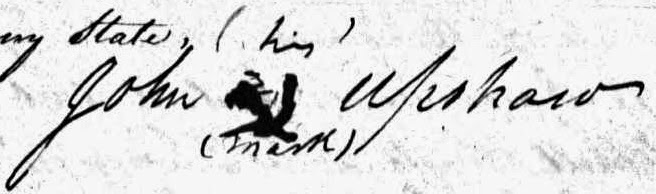
I also find it interesting that John Upshaw could not sign his name on his application like John Threadgill could. The following is a copy of his "mark" which served as his signature on his Pension Application.
In regards to the DAR, so far 19 Daughters have successfully filed under this Patriot. As of this writing, Daughters have successfully shown lineage under the following children of John and Amy:
John was born 22 February 1755 in Essex County, Virginia.
 |
| Taken from his Pension Application. John states he was born in Essex County, VA on 22 February 1755 |
According to his pension application, John served under a number of officers in his time in the Revolutionary War. First, he was drafted and served for three months as a Private with Captain William Tucker and Colonel Dabney. (His father-in-law, Larkin Gatewood, was a Sergeant with Captain William Tucker. I am curious if that had anything to do with his being drafted.)
 |
| Taken from Pension Application |
 |
| Taken from Pension Application |
 |
| Taken from Pension Application |
 |
| Sketch of the Albemarle Barracks Artist unknown |
I find John Upshaw's story to be very different from the story of my other ancestor, John Threadgill. John Threadgill enlisted before the signing of the Declaration of Independence. He also fought for the American cause for a consecutive year.
John Upshaw, on the other hand, did not voluntarily enlist. He was drafted, not once, but four times. And his service wasn't until the later half of the War. Also, he only served for periods of a month or two before heading back home to his family. I wonder if the differences in their family lives influenced their different stories.
John Upshaw got married before his service. John Threadgill didn't seem to get married until after he served. Perhaps John Upshaw felt more of a duty to being home caring for his new bride than serving on the battlefield, whereas John Threadgill did not yet have a family waiting for him at home.
I also find it interesting that John Upshaw could not sign his name on his application like John Threadgill could. The following is a copy of his "mark" which served as his signature on his Pension Application.
 |
| John's mark as found in his Pension Application |
- Sarah R. Upshaw
- George L. Upshaw
- James Upshaw
- John Upshaw
I have yet to uncover any additional children for this couple, but I have not investigated this family very deeply. If I find any other children born to this union, I will post their names, if not here on this post, on a future post.
Sources:
- John Upshaw's Pension Application (accessed on Ancestry)
- Sketch of the Albemarle Barracks is currently unsourced. Found in a Google Search as being present on several blogs also unsourced.
Sunday, February 15, 2015
John Threadgill
For my first Patriot on this site, I have decided to highlight my own Patriot Ancestor in the DAR, John Threadgill (or as the DAR spells it "John Threldkeld"). The following is an excerpt from the Veterans' Day speech I gave at my husband's school this past November. I've added some relative clippings from his and his wife's pension applications. He is, of course, an already "proven" Patriot, so any woman who can prove that she descends from this man can be admitted into the Daughters of the American Revolution. After the speech excerpt, I will provide some further information on his immediate descendants.
"John Threadgill was the fourth child of John and Anabel Threlkeld. He was born on the 17th of November 1750 in North Carolina. He and his brothers and sisters were the first in their family to be born on American soil. His grandfather, Deodatus, who had French roots, traveled from England to the colony of Virginia, by way of Bermuda, just as the Virginia Company and several others had in those days. John’s father, who was also named John, was born while Deodatus was in Bermuda.
Now, Bermuda was a great asset to the colonies during the Revolution, providing ships, salt, and gunpowder. Some say they were so supportive of the American cause that, were they not so far from the mainland, they would have become the 14th colony to join the fight. So, maybe John was persuaded to fight for the Revolution because of his Bermudian influence, or maybe, since he came from a line of goldsmiths and watch makers, he felt compelled to defend his home which mostly depended on merchants and traders, or maybe there was another reason, but John enlisted in the Continental Army in September of 1775. He served in the 2nd Virginia Regiment under Colonel William Woodford, Lieutenant Colonel Charles Scott, and Captain Richard Meade.
 |
| Excerpt from Mary Cob Threadgill's widow's pension application describing John Threadgill's service. |
 |
| Excerpt from John Threadgill's pension application where he recounts his service in the American Revolution. |
Before we get to the battle in which John fought, a little backstory. Up until this point, Virginia had been pretty quiet. Most of the action prior to this had taken place in the northern colonies, like Massachusetts. But in Virginia, there was a road, called the Great Road, which came up from North Carolina and served as the primary route for transporting tar, pitch, and turpentine to the Chesapeake Bay where the British kept and repaired their ships. This area was also important in the transport of food and livestock to northern colonies and to England as well.The port town of Norfolk was where the British fleet often took anchor gathering supplies and forces. Colonel Woodford saw the importance of this region to the Loyalists. The American Navy was still a new endeavor, but the British Navy was strong, making this port town impossible to attack from sea. Great Bridge, a nearby town, was the only landward passage into Norfolk and, therefore, was Lord Dunmore and the British Army’s Achilles’ heel. For this very reason, Colonel Woodford decided to attack.
But Lord Dunmore wouldn’t go down without a fight! Hearing of the rebel forces moving in on Great Bridge, Dunmore moved his troops to meet them. Dunmore’s first encounter with the patriots happened about 10 miles outside the town where the Princess Anne militia was waiting. The British, with double the men in their army compared to the militia, easily defeated them causing them to retreat into the swamps. After that small victory, no doubt Lord Dunmore knew there was no way these rebels could take his town!
These small skirmishes went on for 11 days. During this time, both sides were recruiting forces. The British even had a unit consisting of runaway slaves on their side thanks to martial law which was passed just a month prior. The British were able to gather the strength of about 670 men. And a “deserter,” a slave from the Marshall household, a well-known Patriot family (who helped organize the Culpeper Minutemen and who gave us our first chief justice of the U.S. Supreme Court), told the Loyalist troops that Woodford only had 300 “shirtmen” gathered at the village of Great Bridge. But the Patriots had in fact recruited around 900.
On the morning of December 9, 1775, the British troops marched out from their fort and began crossing the bridge to attack the Patriots’ breastwork, which was positioned on the southside of the causeway. The Patriots were hiding in the trenches nearby on the island and opened fire on the British soldiers. Unlike in previous battles where the soldiers would shoot early and miss their targets, these rebels waited until their targets were about 50 feet away before shooting and then retreating further into the wood to the breastwork where more forces were waiting. The battle itself only lasted about 30 minutes, but the result was incredible.
Which side do you think won?
The Rebels!
The rebel victory at Great Bridge proved to be key in the goal of American Independence. It was, obviously, great for patriotic moral. With 102 British men killed or wounded and only one rebel wounded (in the thumb!) in the battle, the win was decisive. Any doubts that a win was possible were quickly put to rest. It also persuaded some citizens who were undecided in betraying the crown to join the cause. It also prompted the Fourth Virginia Convention and the first open public debate on Independence. It enabled rebel forces to advance to Norfolk, which was later burned, and forced Lord Dunmore and the Loyalists to ultimately abandon Virginia, which was a valuable resource for supplies, leaving all of the area’s goods for the patriots. (This, in itself, became key to the British surrender at Yorktown in 1781.) And lastly, it elevated Colonel Woodford, commander of the 2nd Virginia Regiment, so much that it influenced Patrick Henry, commander of the 1st Virginia Regiment and already famous for his speech where he said “Give me Liberty or Give me Death!” to leave the military and become the first Governor of Virginia.
Thanks to my ancestor, John Threadgill, and others like him that fought in the Revolution, I’m an American, and I’m very grateful for that. I’m grateful to all the veterans who came after him too and everyone who has helped defend this great country and who has fought for our freedoms."
 |
| John Threadgill's signature as found following his personal statement in his pension application. |

As of this writing, Daughters have successfully joined the DAR under the following children of John and Mary:
- Elizabeth
- George
- Howell
- Lucy
- Randall (spelled "Randle" in the pension application)
- William
- Ann
- Jane
- John
- Martha
- Mary
- Sarah
- Thomas
Keep in mind that some of these lines may not contain living descendants. But so far I have not followed out these remaining lines to see how they develop. That's a post for another day.
Sources:
- John Threadgill's Pension Application (found on Ancestry)
- Mary Cob Threadgill's Widow's Pension Application (found on Ancestry)
- www.gbbattlefield.org
- www.ushistory.org
Subscribe to:
Posts (Atom)