Showing posts with label Virginia. Show all posts

Sunday, August 16, 2015

Frost And Snow

This has to be my favorite Patriot of late. I came across this man while researching a line I thought I had figured out... until I realized I had some misinformation. Wasn't it lucky though that I did! Otherwise, I probably never would have even known this man existed.

Believe me when I tell you: you did not read the name in the title of this post incorrectly. This Patriot's name is "Frost," middle name "And," and surname "Snow." Let me share his story with you!
Clipping of Pension Envelope
Frost And Snow served several times during the Revolutionary War. He first served under the command of Captain James Head. Under Captain Head, he marched from the Orange County, Virginia through Culpeper and Farquier Counties. During this time, he also guarded some British prisoners. He eventually ended up in Albemarle (I'm wondering if he was referring to the Albemarle Barracks where my ancestor also served), where he remained until he was later discharged. This service period lasted about two months.
Clipping from Pension Record describing his service under Captain James Head
During his second enlistment with the Army, Frost And Snow served under Captain Isaac Davis, who was a member of Colonel Lindsey's Regiment. Frost mentions in his pension application that he served as a substitute soldier for a man named John Burrows who was supposed to march from the Albemarle Courthouse to Culpeper County during a time "where it being understood that General [George] Washington and Gen. Wa(?) were coming on with reinforcements Lord Cornwallis and Col. Tarlton retreated." Frost mentions that they marched until they arrived at a place a I can't quite make out in his pension record. It looks something like Alubbins or Mubbins Hill, but that doesn't ring any bells for me. During this period, Frost ended up serving another two months before being discharged again.
Clipping from Pension Record showing the place I can't make out
During Frost's final tour with the Army, he served under Captain Coger or Coker and Lieutenant Robinson "in the year Cornwallis was captured at Yorktown." He states he entered service in Augusta County, VA as a substitute for John Smith. While serving under Captain Coger/Coker, he marched from Augusta to Yorktown and remained there until Cornwallis surrendered. After the surrender, he recalls that he marched from Yorktown to Winchester and was in charge of the prisoners taken by General Washington. This final stretch of service also lasted about two months.

Frost And Snow is assumed to be a "junior." His assumed parents are Frost And Snow, Sr. and Elizabeth Ballard. I have not found any proof of this myself yet. The only mention the Patriot Frost makes of his father in his pension record is when he states that his father never kept records of his birth. He, therefore, "believes himself to be 78 years of age" at the time of his pension application hearing in 1837. This would make Frost And Snow to have been born about 1759.
Clipping from Pension Record showing Frost's guesstimation of his age
This family is a bit of a tangled mess for me. I found this family while researching my husband's Southard family, which I posted about in my blog for his family a little while ago. While I know this family is connected to my husband's family, I have yet to figure out how.

As I uncover more information about this Frost And Snow, however, I am led to believe that the information about him in the DAR Genealogical Research System (GRS) is incorrect. It seems Frost And Snow's father may have also been named Frost And Snow, and that the Elizabeth Ballard that is listed as Patriot Frost's wife in the GRS Database may actually be his mother. I hope to get this family sorted out soon. Hopefully a closer look at the sources and information provided by the five Daughters who have used Frost as their Patriot to join the Daughters of the American Revolution will help.

Sources:
  • Frost And Snow's Pension Application (accessed on Fold3)

Saturday, July 4, 2015

239th Anniversary of American Independence

Today is an American holiday. We celebrate today as the birth of our country. Today is not the day the Declaration of Independence was signed, or even when the Continental Congress began meeting to discuss our breaking free from England. Today is merely the day Continental Congress finalized the wording of the Declaration as shown by the date printed on the final copy. Even still, this is the day we celebrate America's birthday.

Continuing with my recent posts about what is considered acceptable service with the DAR, Signers of the Declaration of Independence are all accepted Patriots of the Daughters of the American Revolution. They are:

From Connecticut:
From Delaware:
From Georgia:
From Maryland:
From Massachusetts:
From New Hampshire:
From New Jersey:
From New York:
From North Carolina:
From Pennsylvania:
From South Carolina:
From Virginia:
I have not followed out the lines of most of these families. I do know at least some of them do still have living descendants. (One of Benjamin Franklin descendants came to a recent DAR Chapter Meeting of mine to teach us about the life of his ancestor.)

The DAR tags a few of them as having no living descendants, and as you can tell from the list above, not all of the signers appear in the DAR database. While it is possible some of the unlinked signers had descendants, I would imagine the likelihood of that would be extremely low given the fact that women have had 125 years to declare their lineage in the society.

While no DAR Patriot is "better" or "worse" than another, or more or less "worthy" because of the type of service he or she did, I have to say signing the Declaration of Independence has to be one of the "coolest" forms of service!

Sources:

Sunday, May 24, 2015

James Higginbotham

This week, I thought I would highlight a Patriot in my family who isn't in my direct line. James Higginbotham is the great-grandfather of a distant cousin of mine. James is also a proven Patriot in the DAR database.

James' children attempted to claim a pension for their father's service in 1832. Benjamin Higginbotham, Frederick Padget, and Anderson Thompson provided affidavits for James Higginbotham's pension application. They presented that James was recruited by Thomas Oglesby to serve in the regular army for a term of eighteen months.

According to the pension, one of the proofs of service provided was a commission bearing the date of 1 November 1775 which appointed James as Major of the Militia of the County of Amherst. The commission was granted by Edmund Pendleton, Thomas Lud Lee, P. Carrington, Dudley Digges, and James Mercer, who were designated as the "Committe of Safety for the Colony of Virginia."
Taken from Pension Application
The pension goes on to say that James enlisted into service in 1775 as a Major of the Militia. Then, in 1778, he was promoted to the rank of Colonel for the Virginia State Line (probably the 9th Virginia Regiment). James' nephew, Benjamin Higginbotham, provides testimony that James served in Williamsburg during at least part of the year 1776 (I think he meant 1775 because he is talking about the time before James' promotion which occurred in November 1775).

Benjamin also mentions that James was stationed at the Albemarle Barracks by 1779. He also mentioned James was at Yorktown in 1781.

Benjamin, supposedly, knew all of this information about James' service because he himself also served in the Revolutionary War. (He also mentioned suppling beef cattle to James' army.)
Taken from Pension Application
According to Benjamin, James served as a recruitment officer for about 18 months at the Amherst County Courthouse. This was one of his chief duties. One of the people providing testimony of James' service, Fredrick Padgett, was one of the many men recruited by James. What Fredrick has to say about James shows James' anything-but-humbling attitude about his service and his faith in the country he fought so hard to free.
"That he has often heard the said James Higginbotham say the Country was largely indebted to him for military services as a Colonel in the State line, that he had never received the compensation due to him, but had confidence that the State, when she could, would do him justice, as he had served her faithfully, and much to the detriment of his private affairs."
Taken from Pension Application
As of this writing, Daughters have joined under James with the following children:
  • Joseph Cabell Higginbotham
  • Judith Higginbotham
  • George Washington Higginbotham
  • James Higginbotham
According to James' pension, these are James' only surviving children in 1832, so all of his known lines are represented in the DAR database.
Taken from Pension Application
Sources:
  • James Higginbotham's Pension Application (accessed on Fold3)

Sunday, March 29, 2015

Richard Beeson

This week, I thought I would highlight someone who is not a direct ancestor of my husband or I. Richard Beeson is a proven Patriot in the DAR database. He is my husband's 5th great-granduncle.

Richard Beeson was born 11 March 1747 in Frederick County, Virginia as the fifth of 12 children born to Benjamin Beeson, Sr and Elizabeth Hunter. He was born to a Quaker family, but when he married his wife, Abigail Dimmitt, around 1768, he was disowned from the Quaker church because she was not of the Quaker faith.

Like Jacob Lineberry, the DAR uses the "North Carolina Revolutionary War Army Accounts" volumes as the source of Richard's "patriotic service." The DAR states that Richard furnished supplies for the War. Since he was originally of Quaker faith, it makes sense that he wouldn't have actually fought for the cause since the Quakers were widely viewed as pacifists.

I don't know much about Richard. What I do know comes from Quaker Meeting Minutes and his will. I assume he was in some kind of trade profession, like farming, carpentry, or machinery, based on his service to the American Revolution, but I have no solid proof of that. Here's what I do know.

Richard and Abigail had (at least) the following children:
  • Abner Beeson
  • Richard Beeson
  • James Beeson
  • Abigail Beeson
  • Littie Beeson
  • Ann Beeson
  • Thomer (or perhaps Thomas?) Beeson
  • Rosanna Beeson
  • Rheuhama Beeson
  • Rachel Beeson
According to his will, he may have had a slave or indentured servant living with him at the time of his death because he refers to a "bound boy named James." (I don't recognize James' last name, but it could be something like Sprashit.)
Taken from Will of Richard Beeson, Sr
The Beesons are never shown in any census record has having any non-white members in the household, so I assume James was white. The Quakers were, in general, against the notions of slavery, but I am unsure their attitudes towards indentured servitude. I hope to track down this James' family to see what became of him at some point.

According to his will, he divided up 937 acres, a majority of it creekside, to his children; and that does not include the land that Richard actually lived on which was willed to his wife, Abigail. I grew up with my grandmother who lived on about six-and-a-half acres, and I thought that was a lot of land. Here, Richard Beeson had around 1,000 acres of land!

I hope to one day get my hands on the "North Carolina Revolutionary War Army Accounts" volumes to see if it contains any additional information about Richard's service to the American cause, but until then I still find myself with questions about him and his role in the Revolution.

As of this writing, Daughters have joined the DAR under Richard via the following children:
  • Lornhama (whom I believe to be the Rheuhama noted in his will)
  • Absolom (who is not listed in Richard's will, which means he could have died before the will was written.)
This leaves nine children unrepresented in the DAR database. I need to follow all of his children's lines out still to make sure they still continue today, but Richard's will notes a few grandchildren, so at least I have a few starting points to check.

Sources:
  • New Garden Quarterly Meeting Minutes (accessed on Ancestry)
  • Will of Richard Beeson (posted on Ancestry by jefre1)
  • 1790 U.S. Federal Census (accessed on Ancestry)
  • 1800 U.S. Federal Census (accessed on Ancestry)
  • 1810 U.S. Federal Census (accessed on Ancestry)

Sunday, March 1, 2015

John Upshaw

John Upshaw is another verified Patriot in the DAR database. He is also another one of my ancestors. In the Daughters of the American Revolution, after you join under your first Patriot, you can submit "supplemental" applications for any other ancestor in your lineage who was also a Patriot. While I have not submitted any supplemental applications yet for myself (they can get costly quickly at $75 a piece), John Upshaw is another person in my lineage that I could use to submit a supplemental application. This is his story.

John was born 22 February 1755 in Essex County, Virginia.
Taken from his Pension Application.
John states he was born in Essex County, VA on 22 February 1755
John married Amy Gatewood on 5 March 1776.

According to his pension application, John served under a number of officers in his time in the Revolutionary War. First, he was drafted and served for three months as a Private with Captain William Tucker and Colonel Dabney. (His father-in-law, Larkin Gatewood, was a Sergeant with Captain William Tucker. I am curious if that had anything to do with his being drafted.)
Taken from Pension Application
During that three months in 1780, he marched from Amherst County, Virginia to Hampton under the Command of Marquis de Lafayette before being discharged.
Taken from Pension Application
Later, he was drafted again and served another two months as a Private under Captain Woodruff, who was under the command of Colonel Merriwether. In 1781, he marched, yet again from Amherst to Hampton, and after having only served for one month, he was discharged again.
Taken from Pension Application
Later in 1781, he was drafted to serve another two months, this time with Captain Dawson. He marched from Amherst to the Albemarle Barracks where he was stationed to Guard the British prisoners being held there. He served in this position for only a month before being discharged again. (As far as I can tell, the Albemarle Barracks ceased to function in the end of 1780. I wonder if John was mistaken on the time he served there.)
Sketch of the Albemarle Barracks
Artist unknown
John was later drafted a fourth time! This time, still being in 1781, he was drafted under Captain Burrows. Under Captain Burrows, he marched from Amherst County to a place near Yorktown. He was in service for one additional month during this term before being discharged.

I find John Upshaw's story to be very different from the story of my other ancestor, John Threadgill. John Threadgill enlisted before the signing of the Declaration of Independence. He also fought for the American cause for a consecutive year.

John Upshaw, on the other hand, did not voluntarily enlist. He was drafted, not once, but four times. And his service wasn't until the later half of the War. Also, he only served for periods of a month or two before heading back home to his family. I wonder if the differences in their family lives influenced their different stories.

John Upshaw got married before his service. John Threadgill didn't seem to get married until after he served. Perhaps John Upshaw felt more of a duty to being home caring for his new bride than serving on the battlefield, whereas John Threadgill did not yet have a family waiting for him at home.

I also find it interesting that John Upshaw could not sign his name on his application like John Threadgill could. The following is a copy of his "mark" which served as his signature on his Pension Application.
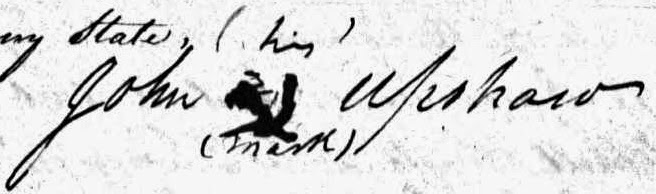
John's mark as found in his Pension Application
In regards to the DAR, so far 19 Daughters have successfully filed under this Patriot. As of this writing, Daughters have successfully shown lineage under the following children of John and Amy:
  • Sarah R. Upshaw
  • George L. Upshaw
  • James Upshaw
  • John Upshaw
I have yet to uncover any additional children for this couple, but I have not investigated this family very deeply. If I find any other children born to this union, I will post their names, if not here on this post, on a future post.

Sources: 
  • John Upshaw's Pension Application (accessed on Ancestry)
  • Sketch of the Albemarle Barracks is currently unsourced. Found in a Google Search as being present on several blogs also unsourced.

Sunday, February 15, 2015

John Threadgill

For my first Patriot on this site, I have decided to highlight my own Patriot Ancestor in the DAR, John Threadgill (or as the DAR spells it "John Threldkeld"). The following is an excerpt from the Veterans' Day speech I gave at my husband's school this past November. I've added some relative clippings from his and his wife's pension applications. He is, of course, an already "proven" Patriot, so any woman who can prove that she descends from this man can be admitted into the Daughters of the American Revolution. After the speech excerpt, I will provide some further information on his immediate descendants.
"John Threadgill was the fourth child of John and Anabel Threlkeld.  He was born on the 17th of November 1750 in North Carolina.  He and his brothers and sisters were the first in their family to be born on American soil.  His grandfather, Deodatus, who had French roots, traveled from England to the colony of Virginia, by way of Bermuda, just as the Virginia Company and several others had in those days.  John’s father, who was also named John, was born while Deodatus was in Bermuda. 
Now, Bermuda was a great asset to the colonies during the Revolution, providing ships, salt, and gunpowder.  Some say they were so supportive of the American cause that, were they not so far from the mainland, they would have become the 14th colony to join the fight.  So, maybe John was persuaded to fight for the Revolution because of his Bermudian influence, or maybe, since he came from a line of goldsmiths and watch makers, he felt compelled to defend his home which mostly depended on merchants and traders, or maybe there was another reason, but John enlisted in the Continental Army in September of 1775.  He served in the 2nd Virginia Regiment under Colonel William Woodford, Lieutenant Colonel Charles Scott, and Captain Richard Meade.
Excerpt from Mary Cob Threadgill's widow's
pension application describing John Threadgill's service.
Excerpt from John Threadgill's pension application
where he recounts his service in the American Revolution.
Before we get to the battle in which John fought, a little backstory.  Up until this point, Virginia had been pretty quiet.  Most of the action prior to this had taken place in the northern colonies, like Massachusetts.  But in Virginia, there was a road, called the Great Road, which came up from North Carolina and served as the primary route for transporting tar, pitch, and turpentine to the Chesapeake Bay where the British kept and repaired their ships.  This area was also important in the transport of food and livestock to northern colonies and to England as well. 

The port town of Norfolk was where the British fleet often took anchor gathering supplies and forces.  Colonel Woodford saw the importance of this region to the Loyalists.  The American Navy was still a new endeavor, but the British Navy was strong, making this port town impossible to attack from sea.  Great Bridge, a nearby town, was the only landward passage into Norfolk and, therefore, was Lord Dunmore and the British Army’s Achilles’ heel.  For this very reason, Colonel Woodford decided to attack. 
But Lord Dunmore wouldn’t go down without a fight!  Hearing of the rebel forces moving in on Great Bridge, Dunmore moved his troops to meet them.  Dunmore’s first encounter with the patriots happened about 10 miles outside the town where the Princess Anne militia was waiting.  The British, with double the men in their army compared to the militia, easily defeated them causing them to retreat into the swamps.  After that small victory, no doubt Lord Dunmore knew there was no way these rebels could take his town! 
These small skirmishes went on for 11 days.  During this time, both sides were recruiting forces.  The British even had a unit consisting of runaway slaves on their side thanks to martial law which was passed just a month prior.  The British were able to gather the strength of about 670 men.  And a “deserter,” a slave from the Marshall household, a well-known Patriot family (who helped organize the Culpeper Minutemen and who gave us our first chief justice of the U.S. Supreme Court), told the Loyalist troops that Woodford only had 300 “shirtmen” gathered at the village of Great Bridge.  But the Patriots had in fact recruited around 900
On the morning of December 9, 1775, the British troops marched out from their fort and began crossing the bridge to attack the Patriots’ breastwork, which was positioned on the southside of the causeway.  The Patriots were hiding in the trenches nearby on the island and opened fire on the British soldiers.  Unlike in previous battles where the soldiers would shoot early and miss their targets, these rebels waited until their targets were about 50 feet away before shooting and then retreating further into the wood to the breastwork where more forces were waiting.  The battle itself only lasted about 30 minutes, but the result was incredible. 
Which side do you think won? 
The Rebels! 
The rebel victory at Great Bridge proved to be key in the goal of American Independence.  It was, obviously, great for patriotic moral.  With 102 British men killed or wounded and only one rebel wounded (in the thumb!) in the battle, the win was decisive.  Any doubts that a win was possible were quickly put to rest.  It also persuaded some citizens who were undecided in betraying the crown to join the cause.  It also prompted the Fourth Virginia Convention and the first open public debate on Independence.  It enabled rebel forces to advance to Norfolk, which was later burned, and forced Lord Dunmore and the Loyalists to ultimately abandon Virginia, which was a valuable resource for supplies, leaving all of the area’s goods for the patriots.  (This, in itself, became key to the British surrender at Yorktown in 1781.)  And lastly, it elevated Colonel Woodford, commander of the 2nd Virginia Regiment, so much that it influenced Patrick Henry, commander of the 1st Virginia Regiment and already famous for his speech where he said “Give me Liberty or Give me Death!” to leave the military and become the first Governor of Virginia. 
Thanks to my ancestor, John Threadgill, and others like him that fought in the Revolution, I’m an American, and I’m very grateful for that.  I’m grateful to all the veterans who came after him too and everyone who has helped defend this great country and who has fought for our freedoms."
John Threadgill's signature as found following
his personal statement in his pension application.
The following photo is a clipping from John's pension application. It references a family "prayer book" and provides a list of John and Mary Threadgill's 13 children.


As of this writing, Daughters have successfully joined the DAR under the following children of John and Mary:
  • Elizabeth
  • George
  • Howell
  • Lucy
  • Randall (spelled "Randle" in the pension application)
  • William
This means, each of the following children would be considered a "new child" for this Patriot (which is a great accomplishment in the organization):
  • Ann
  • Jane
  • John
  • Martha
  • Mary
  • Sarah
  • Thomas
Keep in mind that some of these lines may not contain living descendants. But so far I have not followed out these remaining lines to see how they develop. That's a post for another day.

Sources: