Saturday, July 4, 2015

239th Anniversary of American Independence

Today is an American holiday. We celebrate today as the birth of our country. Today is not the day the Declaration of Independence was signed, or even when the Continental Congress began meeting to discuss our breaking free from England. Today is merely the day Continental Congress finalized the wording of the Declaration as shown by the date printed on the final copy. Even still, this is the day we celebrate America's birthday.

Continuing with my recent posts about what is considered acceptable service with the DAR, Signers of the Declaration of Independence are all accepted Patriots of the Daughters of the American Revolution. They are:

From Connecticut:
From Delaware:
From Georgia:
From Maryland:
From Massachusetts:
From New Hampshire:
From New Jersey:
From New York:
From North Carolina:
From Pennsylvania:
From South Carolina:
From Virginia:
I have not followed out the lines of most of these families. I do know at least some of them do still have living descendants. (One of Benjamin Franklin descendants came to a recent DAR Chapter Meeting of mine to teach us about the life of his ancestor.)

The DAR tags a few of them as having no living descendants, and as you can tell from the list above, not all of the signers appear in the DAR database. While it is possible some of the unlinked signers had descendants, I would imagine the likelihood of that would be extremely low given the fact that women have had 125 years to declare their lineage in the society.

While no DAR Patriot is "better" or "worse" than another, or more or less "worthy" because of the type of service he or she did, I have to say signing the Declaration of Independence has to be one of the "coolest" forms of service!

Sources:

Sunday, June 21, 2015

Types of Patriotic Service Accepted by the DAR

This is the second of a four-part series related to the types of service acceptable by the Daughters of the American Revolution. You can read my prior post on acceptable Civil Service here.

Patriotic Service entails that a man or woman, by act or by a series of actions, "demonstrated unfailing loyalty to the cause of American Independence from England." This is how most women begin to prove themselves as Patriots. This is also how most elderly men, fathers and grandfathers of men who served in the militias, proved themselves as Patriots. Even a few children have proven themselves as Patriots through the Patriotic Service category.

It is also important to note the timeframe when service may be credited. Patriotic Service may be credited as soon as April 1774 and may continue up until about 1783. The following list attempts to describe a few of the types of acts or actions that can be credited as "Patriotic Service."
  • Members of the Continental Congress, State Conventions, and Assemblies (see Henry Abbott)
  • State Governors and Legislators (but not including Royal Governors) (see Jonathan Bacon)
  • Membership in committees made necessary by the War, including service on committees which furthered the cause of the Colonies from April 1774, such as Committees of Correspondence, Inspection, and Safety, committees to care for soldier's families, etc. (see Asa Abbott)
  • Signer of the Oath of Fidelity and Support (see Reinholt Abendschon)
  • Signer of the Oath of Allegiance (see Jacob Abel)
  • Signer of other such Oath (see Benjamin Abbott)
  • Member of the Boston Tea Party (see Nathaniel Bradley)
  • Defender of Forts, Stations, and Frontiers (see Joshua Baker)
  • Signers of petitions addressed to and recognizing the authority of the Provisional and new State Governments (not including religious petitions) (see John Abbott)
  • Doctors, nurses and others rendering aid to the wounded (other than their immediate families) (see Nathaniel Abney)
  • Ministers who gave patriotic sermons and encouraged patriotic activity (see James Campbell)
  • Furnishing a substitute for military service (see Stephen Ackley)
  • Prisoners of war or refugees from occupying forces (see Samuel Babson)
  • Prisoner on the British ship, Old Jersey, or other prison ships (see Daniel Abrahams)
  • Service in the Spanish Troops under Galvez or the Louisiana Militia after 24 December 1776 (see Jean Baptiste Etienne Adle)
  • Service performed by French nationals within the colonies or in Europe in support of the American cause (see Jean Audubon)
  • Those who rendered material aid, in Spanish America, by supplying cattle for Galvez's forces after 24 December 1776 (see Antonio Armenta)
  • Those who applied in Virginia for Certificates of Rights to land for settlement and those who were entitled to and were granted preemption rights (see James Allen)
  • Those who took the Oath of Fidelity to the Commonwealth of Virginia from October 1779 to 26 November 1783 (I could not find a reference to this service in the records that I checked)
  • Those who rendered material aid such as furnishing supplies with or without remuneration, lending money to the Colonies, munitions makers, gunsmiths, etc. (see James Abbott)
  • Claiming damages by the British during the War (see Johannes Ackerman)
The great thing about Patriotic Service is that this list isn't all-inclusive. So long as you can provide documentation that the act took place, and so long as you can provide justification on the significance of that act as it relates to the fight for Independence, you can establish a new method of Patriotic Service. The possibilities are almost endless!

Since there are various ways to have provided Patriotic Service, there are also various ways to prove Patriotic Service. They may be kept in various places too.

Some town, county, state, and federal records can provide evidence of service. Some genealogical magazine articles or publications can include lists of people who provided aid or signed Oaths where the original documents have since been lost. Some books, whether published privately or by an institution or society, can also reproduce minutes of meetings and/or lists of men and women eligible for service. Also, letters, diaries, and other family papers can be used if they were produced at the time of the event or the writer lived at a time that he or she would have known the subject personally. That last one can prove to be tricky, so be careful there.

See Debbie Duay's website for a full list of current Revolutionary War Service Sources.

Sunday, June 7, 2015

Types of Civil Service Accepted by the DAR

Over the next several posts, I will attempt to describe the various types of service acceptable by the Daughters of the American Revolution for Patriots. Patriots within the DAR must have, "with unfailing loyalty to the cause of American Independence, served as a sailor, soldier, civil officer, or rendered acceptable patriotic service."

The DAR requires that applicants trying to prove a "new" Patriot submit proof of their ancestor's service as well as their residence during time of service. Federal records are acceptable. Contemporary letters from the ancestor or a person who knew the ancestor personally are acceptable. But rather than discuss the types of sources one can use to prove service, I want to focus instead on the types of service possible.

The first type I hope to describe is civil service. This requires that the Patriot conducted business under the authority of the new federal, state, county, and/or town governments while being loyal to America's separation from the crown.

Civil service is said to begin after the royal governor(s) were removed from power and when a statewide American government was formed. Also, Americans must have gained control of the area. Cities and states still being occupied by the British are not eligible locations for civil service to have been performed.

Now I will offer some examples of offices or officials that qualify as civil service positions with the DAR.
This is not an exhaustive list, but it provides a general idea of the types of positions eligible.

See Debbie Duay's website for a full list of current Revolutionary War Service Sources.

Sunday, May 24, 2015

James Higginbotham

This week, I thought I would highlight a Patriot in my family who isn't in my direct line. James Higginbotham is the great-grandfather of a distant cousin of mine. James is also a proven Patriot in the DAR database.

James' children attempted to claim a pension for their father's service in 1832. Benjamin Higginbotham, Frederick Padget, and Anderson Thompson provided affidavits for James Higginbotham's pension application. They presented that James was recruited by Thomas Oglesby to serve in the regular army for a term of eighteen months.

According to the pension, one of the proofs of service provided was a commission bearing the date of 1 November 1775 which appointed James as Major of the Militia of the County of Amherst. The commission was granted by Edmund Pendleton, Thomas Lud Lee, P. Carrington, Dudley Digges, and James Mercer, who were designated as the "Committe of Safety for the Colony of Virginia."
Taken from Pension Application
The pension goes on to say that James enlisted into service in 1775 as a Major of the Militia. Then, in 1778, he was promoted to the rank of Colonel for the Virginia State Line (probably the 9th Virginia Regiment). James' nephew, Benjamin Higginbotham, provides testimony that James served in Williamsburg during at least part of the year 1776 (I think he meant 1775 because he is talking about the time before James' promotion which occurred in November 1775).

Benjamin also mentions that James was stationed at the Albemarle Barracks by 1779. He also mentioned James was at Yorktown in 1781.

Benjamin, supposedly, knew all of this information about James' service because he himself also served in the Revolutionary War. (He also mentioned suppling beef cattle to James' army.)
Taken from Pension Application
According to Benjamin, James served as a recruitment officer for about 18 months at the Amherst County Courthouse. This was one of his chief duties. One of the people providing testimony of James' service, Fredrick Padgett, was one of the many men recruited by James. What Fredrick has to say about James shows James' anything-but-humbling attitude about his service and his faith in the country he fought so hard to free.
"That he has often heard the said James Higginbotham say the Country was largely indebted to him for military services as a Colonel in the State line, that he had never received the compensation due to him, but had confidence that the State, when she could, would do him justice, as he had served her faithfully, and much to the detriment of his private affairs."
Taken from Pension Application
As of this writing, Daughters have joined under James with the following children:
  • Joseph Cabell Higginbotham
  • Judith Higginbotham
  • George Washington Higginbotham
  • James Higginbotham
According to James' pension, these are James' only surviving children in 1832, so all of his known lines are represented in the DAR database.
Taken from Pension Application
Sources:
  • James Higginbotham's Pension Application (accessed on Fold3)

Sunday, May 10, 2015

Benjamin Beeson

Benjamin Beeson is a verified Patriot in the DAR Database. He was born 14 January 1715 to Richard and Charity Grubb Beeson. Benjamin and his family is rather special to me because my husband and I connect through this family via a few intermarriages of our families. (I love seeing families that married or had friendships centuries ago coming back together in later generations!)

Following my recent trends of service amongst the Patriots in this blog, Benjamin was also given his Patriot status because of "patriotic service." His source of service is from the same record as the other three men I have mentioned too: "North Carolina Revolutionary War Army Accounts." He is credited as having "furnished supplies" for the War. As a Quaker by faith, it makes sense that he would not have taken up arms against the British in the War (even though his son, Edward served as a Captain in the War).

Benjamin married Elizabeth Hunter in 1738. According to the New Garden (located in Guilford County, North Carolina) Monthly Meeting Minutes, Benjamin and Elizabeth had the following children:
  • Isaac Beeson (born 26 December 1739)
  • Benj. Beeson (born 9 February 174?)
  • William Beeson (born 11 November 1743/1744)
  • Frances Beeson (born 10 December 174?)
  • Richard Beeson (born 11 March 1747)
  • Ann Beeson (born 3 May 1749)
  • Charity Beeson (born 25 August 1751)
  • Betty Beeson (born 30 July 1754)
  • Edward Beeson (born 1 January 1757)
  • Rachel Beeson (born 14 February 1759)
  • Jane Beeson (born 22 March 1760)
  • Mary Beeson (born 21 September 1762)
Taken from New Garden Monthly Meeting Minutes
So far, in the DAR, Daughters have joined under Benjamin through the following children:
  • Isaac Beeson
  • Benj. Beeson
  • William Beeson
  • Frances Beeson
  • Richard Beeson (see my post here about Richard)
  • Ann Beeson
  • Edward Beeson
  • Jane Beeson
This leaves the following children without descendants represented in the DAR database:
  • Charity Beeson
  • Betty Beeson
  • Rachel Beeson
  • Mary Beeson
I have not followed these lines out myself yet to see if they contain any present-day descendants, but I do know that Elizabeth (Betty) married a man named Joab Elliott.

Feel free to use the Monthly Meeting Page shown above as your link from Charity, Betty, Rachel, or Mary to Benjamin if you would like to enter the DAR through one of those "new child" lines. Also, if you have other Quaker ancestors, remember that the Meeting Minutes are a valuable resource for genealogical information! Most of them are available at a good genealogy-based library or through Ancestry or FamilySearch.

Sources:
  • Centre Monthly Meeting Minutes (accessed at the Florida State Society Daughters of the American Revolution Library, Orlando, Orange County, Florida)
  • Deep River Monthly Meeting Minutes (accessed at the Florida State Society Daughters of the American Revolution Library, Orlando, Orange County, Florida)
  • New Garden Monthly Meeting Minutes (accessed at the Florida State Society Daughters of the American Revolution Library, Orlando, Orange County, Florida)

Sunday, April 26, 2015

Martha Bowdoin

This week, I thought I would tackle a "coded" Patriot as well as my first female Patriot. Martha Bowdoin is a "coded" Patriot in the DAR database. For various reasons, men and women have been "red-lined" in the database preventing their being used for future applicants unless someone fixes whatever problem the DAR has discovered along the way. There are many things that could cause someone to be red-lined, and there are many different "codes," but Martha's code is "Future Applications Must Prove Correct Service," or "FAMPCS."

FAMPCS says, "The proof of service used to establish this person as a patriot is no longer valid. Subsequent evaluation of the proof of service may have determined that the proof is not acceptable under today's standards (examples: tombstone, obituary, undocumented genealogy or county history, family tradition); the service belongs to another person of the same name; the residence of this person during the Revolution is inconsistent with the service, or multiple people have claimed the same service. Future applicants must provide proof of service (and possibly residence) that meets current standards." So, since the status of a Patriot is determined solely on the proof of the service they provided in the founding of our country, this is probably the most serious of all of the "codes" in the database.

As for Martha's service, legend has it that, when Martha was a mere 12-year-old girl, she delayed the Tories, who had intruded upon her family demanding a home-cooked meal, by turning their horses loose out of the barnyard. A small act, but one that took courage and a true American spirit.

Since proving that story would probably be the hardest thing to try to do without lucking upon a diary or letter written in the time, the best efforts for clearing Martha's FAMPCS code would be the find a new service altogether. I would imagine the best place to look for a new source of service for Martha would be that (seemingly) go-to source for North Carolina patriotic service, "North Carolina Revolutionary War Army Accounts." I also hope to figure out what they "originally" had as a source of service for Martha as that would probably be a good start on where to find new service for her.

Martha came from a family that all provided some kind of service to the American efforts. Her father furnished supplies, her sister Elizabeth's husband (John Macon) was a member of the board of auditors and also furnished supplies, and her father-in-law (Nehemiah Odell) rendered material aid. I'm sure in the midst of a family like that, Martha has to have some kind of record proving her allegiance to the American cause.

Here's what I do know about Martha (though mostly from family legend). She was born 13 Nov 1768 in North Carolina to William Boudouin and Elizabeth Macon. (This means the legend of her run-in with the Tories took place about 1780.) She married Isaac Odell sometime before or around 1790 (since they seem to be living together in the 1790 census). She died in 1800 in Randolph County, North Carolina.
Clipping from 1790 census showing one "tick mark" for Isaac and one (presumably) for Martha
As for Martha's descendants, I have not traced this family very much myself. I know, so far, of the name of the single child who is listed in the DAR.
  • James Alexander Odell
According to census records, it appears as though the couple had at least a few more children (at least another son and two daughters), but I have not yet located a will, pension, or land record for this family in order to place names to the "tick marks" on the early census records.
Clipping from 1800 census showing one "tick mark" for Isaac, one (possibly) for Martha, one for a son under 10,
one for a son aged 16-25, and two for a daughter under 10
If you happen to know the names of the other children born to this marriage, or if you think you have proven the family legend of her service, let me know! I would love to see her opened back up for future applicants.

Sources:
  • 1790 Randolph County, North Carolina U.S. Federal Census (accessed on Ancestry)
  • 1800 Hillsboro, Randolph County, North Carolina U.S. Federal Census (accessed on Ancestry)

Sunday, April 12, 2015

George Coble

I thought I would continue the idea of my last post and go with another Patriot that is not a direct ancestor of me or my husband. George Coble is in my husband's tree, but he is not in my husband's line. NOTE: I have not researched this family very much yet, so a lot of the information that follows is based on other people's research. I have not been able to prove or disprove any of it myself beyond what I site below.

George Coble was born 10 May 1733 in Germany. I am unsure when he or his family immigrated to America, but I assume it would have been at least before George got married since he married a Virginian.

George married Maria Barbara Glass. She was born 4 April 1735. (Rumor has it her mother was a Coble too.) 

George died 21 June 1816 in Greensboro, Guilford County, North Carolina. He is buried at Cobles Lutheran Cemetery in Julian, Guilford County, North Carolina.
George Coble tombstone
Added to Find-A-Grave 2 April 2010 by David
George is a proven Patriot in the DAR database. As with Richard and Jacob, George was granted his Patriot status because of "patriotic service." His source of service is from the same record too: "North Carolina Revolutionary War Army Accounts." I really need to get a hold of this book since so many of our relatives appear in it!

I don't know much about George or his families' occupations or trades, so I can't even venture a guess as to what kind of "services" George could have "rendered" in support of the Patriots. In general, I know relatively little about my husband's Coble line (his great-grandmother was a Coble). They mostly lived outside the county where most of my husband's family lived, so they tend to get left out of a lot of my research attempts on his family.

George and Maria had (at least) the following children:
  • Dorothy Coble
  • Philip Coble
  • Mary Coble
  • Paul Coble
  • Jacob Coble
  • Peter Coble
  • Molly Coble
  • Frederick Coble
  • John Nicholas Coble
As I mentioned earlier, I haven't researched this family much myself, but here's what I've so far tried:
  1. I attempted to find a will for this family and could not.
  2. I attempted to find any Revolutionary War-era records that could list children and could not.
  3. I have not found a record of him serving in the War yet or mentioned in a pension. (Since he is listed in the DAR as giving "patriotic service," the likelihood of finding previously undocumented military service is low but possible.)
  4. I have not found a land record, patent, or deed for him in either Virginia or North Carolina.
These attempts were all done online, so of course any non-uploaded records that may still be in existence need to be checked. I also still need to research the (potential) children and see if I can find any records for them which would tie them back into either parent. Also, obviously the Daughters who have joined under George had proof of at least their own line(s), so I still need to look at their applications and see what sources they provided for their applications.

As of this writing, Daughters have joined the DAR under the following children of George's:
  • Philip Coble (only one member has joined under Philip, and she is the most recent applicant to join under George)
  • Paul Coble (five members have joined under him)
Sources:

Sunday, March 29, 2015

Richard Beeson

This week, I thought I would highlight someone who is not a direct ancestor of my husband or I. Richard Beeson is a proven Patriot in the DAR database. He is my husband's 5th great-granduncle.

Richard Beeson was born 11 March 1747 in Frederick County, Virginia as the fifth of 12 children born to Benjamin Beeson, Sr and Elizabeth Hunter. He was born to a Quaker family, but when he married his wife, Abigail Dimmitt, around 1768, he was disowned from the Quaker church because she was not of the Quaker faith.

Like Jacob Lineberry, the DAR uses the "North Carolina Revolutionary War Army Accounts" volumes as the source of Richard's "patriotic service." The DAR states that Richard furnished supplies for the War. Since he was originally of Quaker faith, it makes sense that he wouldn't have actually fought for the cause since the Quakers were widely viewed as pacifists.

I don't know much about Richard. What I do know comes from Quaker Meeting Minutes and his will. I assume he was in some kind of trade profession, like farming, carpentry, or machinery, based on his service to the American Revolution, but I have no solid proof of that. Here's what I do know.

Richard and Abigail had (at least) the following children:
  • Abner Beeson
  • Richard Beeson
  • James Beeson
  • Abigail Beeson
  • Littie Beeson
  • Ann Beeson
  • Thomer (or perhaps Thomas?) Beeson
  • Rosanna Beeson
  • Rheuhama Beeson
  • Rachel Beeson
According to his will, he may have had a slave or indentured servant living with him at the time of his death because he refers to a "bound boy named James." (I don't recognize James' last name, but it could be something like Sprashit.)
Taken from Will of Richard Beeson, Sr
The Beesons are never shown in any census record has having any non-white members in the household, so I assume James was white. The Quakers were, in general, against the notions of slavery, but I am unsure their attitudes towards indentured servitude. I hope to track down this James' family to see what became of him at some point.

According to his will, he divided up 937 acres, a majority of it creekside, to his children; and that does not include the land that Richard actually lived on which was willed to his wife, Abigail. I grew up with my grandmother who lived on about six-and-a-half acres, and I thought that was a lot of land. Here, Richard Beeson had around 1,000 acres of land!

I hope to one day get my hands on the "North Carolina Revolutionary War Army Accounts" volumes to see if it contains any additional information about Richard's service to the American cause, but until then I still find myself with questions about him and his role in the Revolution.

As of this writing, Daughters have joined the DAR under Richard via the following children:
  • Lornhama (whom I believe to be the Rheuhama noted in his will)
  • Absolom (who is not listed in Richard's will, which means he could have died before the will was written.)
This leaves nine children unrepresented in the DAR database. I need to follow all of his children's lines out still to make sure they still continue today, but Richard's will notes a few grandchildren, so at least I have a few starting points to check.

Sources:
  • New Garden Quarterly Meeting Minutes (accessed on Ancestry)
  • Will of Richard Beeson (posted on Ancestry by jefre1)
  • 1790 U.S. Federal Census (accessed on Ancestry)
  • 1800 U.S. Federal Census (accessed on Ancestry)
  • 1810 U.S. Federal Census (accessed on Ancestry)

Sunday, March 15, 2015

Jacob Lineberry, III

In my first post on my Civil War Souls blog, I posted about W. S. Lineberry. In addition to all of his personal and military accomplishments, he wrote a "Biography on the Lineberry Family." In this Biography, he tells a story of his great-grandfather, Jacob Lineberry, in the time of the Revolutionary War. This is what he says about him.
"There is an incident connected with my great-grand-father Jacob Lineberry that I feel bound to relate. In the time of the Revolutionary War he was a Whig. (God bless the name; I love it yet.) He came home at one time to see his family and get something to eat. Old grandmother got the big oven by the fire and was cooking him a big corn pone which we older ones loved, but the present generation knows but little of, and I must say that they have missed a great treat if they never tasted pone bread. 
Those who have read the history of the Revolution know how David Fanning, a British officer who commanded a company of men, mostly Tories, ravished the country from Fayetteville up to the mouth of Deep River, and how they committed murder, rape and arson, and how they left their path destitute wherever they went, committing all kinds of depredations.
North Carolina Highway Marker "Tory Raid"
Grand-father was sitting by the fire waiting for his bread, when some of the family looked out and said, Dave Fanning is coming! Grandfather seized his gun and poked it through a crack in the wall and took aim at Dave and no doubt would have brought him down, as he was said to be a good marksman, but grandmother seized his arm and with tears in her eyes begged him not to kill him, for if he did his men would murder the whole family. 
I imagine I can see him now, brave man that he was, standing there meditating what to do. Finally for the sake of his family he withdrew his gun, jumped out at the back door and ran. The Tories fired several shots at him, but their shots went wild and he made his escape. Some of the family took the bread, ran upstairs and hid it in the big chest, but Fanning's men smelled it and never left the house until they found it and carried it with them."
W. S. Lineberry's story about his great-grandfather, Jacob, is one of my favorites in this line of my husband's family. He has told the story a few times, but the facts always stay the same. I love tracing family stories down the generations, and this is a good one!

Jacob Lineberry is a proven DAR ancestor in their database, but unlike the other patriots I've covered in this blog, I haven't found a pension record, rejected or approved, for Jacob or his wife. The source of service the DAR uses for Jacob is the "North Carolina Revolutionary War Army Accounts" volumes. He is listed under the category of "patriotic service" having been paid for services or supplies.

According to the W. S. Lineberry stories, Jacob was away at camp before he came home for the home-cooked meal mentioned. I am still looking for information on his involvement in the camp. I need to order the microfilm of the source the DAR mentions in his Patriot file. That would be a good starting point, I think.

As for his descendants, so far Daughters have joined under the following children of Jacob's:
  • Samuel
  • Jacob
  • George
This leaves a whopping eight children unaccounted for lineage! Here are the children of Jacob and Mary Catherine who would be considered "new children" in the eyes of the DAR:
  • Francis (W. S. Lineberry's own grandfather)
  • John
  • James
  • Thomas
  • Solomon
  • Catherine
  • Mary
  • Elizy Amey
I have traced all of these lines out except for Mary's. (Mary married a man with a common name for the area, and I am struggling to untangle each of the various families.) Even still, it seems Mary and her husband had children at least, so that means all of Jacob's children had descendants meaning all of Jacob's children should appear in the DAR database. They are simply waiting for people to join under them!

This family is a huge research interest of mine. If you or anyone you know descend(s) from this brave man and you're interested in joining the DAR, send me an email! I would love to help you on that journey and get this man's children accounted for in the DAR database.

Sources:

Sunday, March 1, 2015

John Upshaw

John Upshaw is another verified Patriot in the DAR database. He is also another one of my ancestors. In the Daughters of the American Revolution, after you join under your first Patriot, you can submit "supplemental" applications for any other ancestor in your lineage who was also a Patriot. While I have not submitted any supplemental applications yet for myself (they can get costly quickly at $75 a piece), John Upshaw is another person in my lineage that I could use to submit a supplemental application. This is his story.

John was born 22 February 1755 in Essex County, Virginia.
Taken from his Pension Application.
John states he was born in Essex County, VA on 22 February 1755
John married Amy Gatewood on 5 March 1776.

According to his pension application, John served under a number of officers in his time in the Revolutionary War. First, he was drafted and served for three months as a Private with Captain William Tucker and Colonel Dabney. (His father-in-law, Larkin Gatewood, was a Sergeant with Captain William Tucker. I am curious if that had anything to do with his being drafted.)
Taken from Pension Application
During that three months in 1780, he marched from Amherst County, Virginia to Hampton under the Command of Marquis de Lafayette before being discharged.
Taken from Pension Application
Later, he was drafted again and served another two months as a Private under Captain Woodruff, who was under the command of Colonel Merriwether. In 1781, he marched, yet again from Amherst to Hampton, and after having only served for one month, he was discharged again.
Taken from Pension Application
Later in 1781, he was drafted to serve another two months, this time with Captain Dawson. He marched from Amherst to the Albemarle Barracks where he was stationed to Guard the British prisoners being held there. He served in this position for only a month before being discharged again. (As far as I can tell, the Albemarle Barracks ceased to function in the end of 1780. I wonder if John was mistaken on the time he served there.)
Sketch of the Albemarle Barracks
Artist unknown
John was later drafted a fourth time! This time, still being in 1781, he was drafted under Captain Burrows. Under Captain Burrows, he marched from Amherst County to a place near Yorktown. He was in service for one additional month during this term before being discharged.

I find John Upshaw's story to be very different from the story of my other ancestor, John Threadgill. John Threadgill enlisted before the signing of the Declaration of Independence. He also fought for the American cause for a consecutive year.

John Upshaw, on the other hand, did not voluntarily enlist. He was drafted, not once, but four times. And his service wasn't until the later half of the War. Also, he only served for periods of a month or two before heading back home to his family. I wonder if the differences in their family lives influenced their different stories.

John Upshaw got married before his service. John Threadgill didn't seem to get married until after he served. Perhaps John Upshaw felt more of a duty to being home caring for his new bride than serving on the battlefield, whereas John Threadgill did not yet have a family waiting for him at home.

I also find it interesting that John Upshaw could not sign his name on his application like John Threadgill could. The following is a copy of his "mark" which served as his signature on his Pension Application.
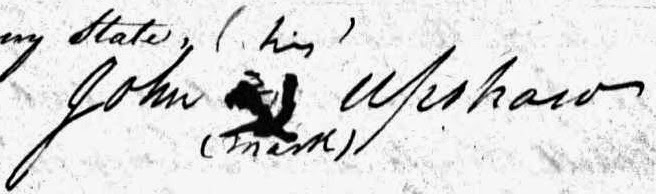
John's mark as found in his Pension Application
In regards to the DAR, so far 19 Daughters have successfully filed under this Patriot. As of this writing, Daughters have successfully shown lineage under the following children of John and Amy:
  • Sarah R. Upshaw
  • George L. Upshaw
  • James Upshaw
  • John Upshaw
I have yet to uncover any additional children for this couple, but I have not investigated this family very deeply. If I find any other children born to this union, I will post their names, if not here on this post, on a future post.

Sources: 
  • John Upshaw's Pension Application (accessed on Ancestry)
  • Sketch of the Albemarle Barracks is currently unsourced. Found in a Google Search as being present on several blogs also unsourced.